
Thursday, September 23, 2010

Holy Terror: The Rise of the Order of Assassins
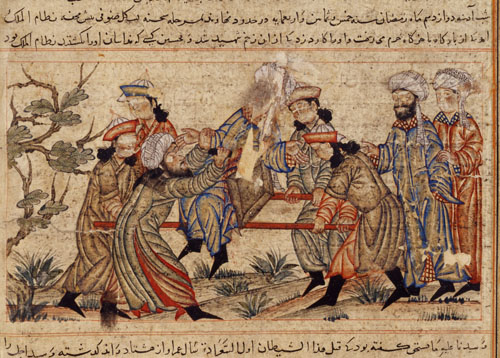
An agent of the Order of Assassins (left, in white turban) fatally stabs Nizam al-Mulk, a Seljuk vizier, in 1092, the first of many political murders by the sect. The faces in this depiction, which was contained in an illustrated 14th-century manuscript, were later scratched out (Topkapi Palace Museum, Cami Al Tebari TSMK, Inv. No. H. 1653, folio 360b)
For almost two centuries, from 1090 until 1273, the Order of Assassins played a singular and sinister role in the Middle East. A small Shiite sect more properly known as the Nizari Ismailis, the Assassins were relatively few, geographically dispersed, and despised as heretics by both the Sunni Muslim majority and even by most other Shiites. By conventional standards, the Assassins should have been no match for the superior conventional military power of any of their many enemies. But near the end of the 11th century, the charismatic and ruthless Hasan-i Sabbah forged this small, persecuted sect into one of the most lethally effective terrorist groups the world has ever known. Even the most powerful and carefully guarded rulers of the age—the Abbasid and Fatimid caliphs, the sultans and viziers of the Great Seljuk and Ayyubid empires, the princes of the Crusader states, and emirs who ruled important cities like Damascus, Homs, and Mosul—lived in dread of the chameleonlike Assassin agents. Known as a fida'i (one who risks his life voluntarily, from the Arabic word for "sacrifice"; the plural in Arabic is fidaiyn, or the present-day fedayeen), such an agent might spend months or even years stalking and infiltrating an enemy of his faith before plunging a dagger into the victim's chest, often in a very public place. Perhaps most terrifying, the Assassins chose not only a close and personal manner of killing but performed it implacably, refusing to flee afterward and appearing to welcome their own swift death.
Fanatical and disciplined, Hasan-i Sabbah and his successors were brilliant practitioners of asymmetric warfare. They developed a means of attack that negated most of their enemies' advantages while requiring the Assassins to hazard only a small number of their own fighters. As with any effective form of deterrence, the Assassins' targeted killings of hostile political, military, and religious leaders eventually produced a stable and lasting balance of power between them and their enemies, reducing the level of conflict and loss of life on both sides.
Today, 750 years after the Mongols crushed them, the Assassins' pioneering use of suicide terrorism, of murdering systematically though at times indiscriminately to achieve political ends, finds chilling echoes in the tactics of terrorist groups like Hamas, Hezbollah, and al Qaeda. But for Hasan-i Sabbah, acts of terror were a legitimate means of self-defense precisely because they focused on high-ranking enemy military, political, and religious leaders who had taken hostile actions against the Ismaili community. There is little doubt he would have viewed the tactics employed by modern Middle Eastern terrorist groups—particularly their targeting of unarmed civilians—with incomprehension and disdain.
After the death of the Prophet Muhammad in 632, the Muslim world was riven into two groups, Sunnis and Shiites. Shiites believed that only a divinely inspired imam could properly interpret the meaning of the Koran, considered by Muslims to contain God's revelations to the prophet Muhammad, and the sayings (hadiths) of Muhammad; that only certain direct descendants of Muhammad's cousin and son-in-law Ali were qualified to assume the role of imam; and that the imam should exercise supreme political as well as spiritual authority over the Muslim community.
The far more numerous Sunnis believed the Koran and hadiths could be understood through diligent study and the guidance of scholars. They accepted the leadership of caliphs who were not direct descendants of Ali.
As the years passed, the Shiite community became further divided, as disagreements arose over which of Ali's living descendants was the divinely guided imam. In the mid-eighth century, the Ismailis chose to follow an imam (Ismail bin Jafar, the seventh imam in their line of succession) who was not accepted by most Shiites. These "Sevener" or Ismaili Shiites, a minority within a minority and the predecessors of the Assassins, were dispersed across the Muslim world. Their faith was characterized by theological sophistication and a radical egalitarianism that condemned the wealth and luxury enjoyed by the Sunni Abbasid caliphs, who ruled most of the Muslim lands from their capital of Baghdad. The main wing of the Shiite movement, known as the "Twelver" Shiites because the line of their imams ended with the twelfth in 872, was most heavily concentrated in parts of what is today Iran, Iraq, Lebanon, Syria, and the Arabian Peninsula. Because both the majority Sunnis and the more numerous Twelver Shiites considered the Ismailis' faith heretical, the Ismailis developed into a clandestine, revolutionary sect that relied upon secret missionaries known as da'is to spread their theology.
One Ismaili da'i, Ubayd Allah, led a successful revolt against a local Sunni dynasty in the area of modern Tunisia and founded the Fatimid caliphate (the name commemorated Fatima, Muhammad's favorite daughter and Ali's wife) in January 910. The Fatimid caliphs conquered Egypt in 969 and then advanced farther east to occupy Palestine, the holy cities of Mecca and Medina, and parts of Syria. They dreamed of capturing Baghdad, dethroning the Abbasids, and uniting the entire Muslim world under their rule. As their star rose, the Fatimids established their capital in Cairo and developed an institutional infrastructure to direct and support their missionary efforts abroad. Ismaili religious activity inside and outside the Fatimid caliphate was supervised by the chief da'i in Cairo, while deputy da'is exercised operational authority for particular regions, selecting and supervising the local da'is who were responsible for spreading Ismaili doctrine.
In the mid-11th century, a vigorous band of Sunni military adventurers from central Asia, the Seljuk Turks, won control of Persia and Mesopotamia and became the new masters of the Abbasid caliphs. At the same time, the Fatimid caliphate was weakened by internal disunity and by the challenge presented by the European Crusaders, who arrived in the Levant and took Jerusalem in 1099. As their power ebbed, the Fatimids lost their conquests in Syria, Arabia, and their original base in Tunisia, reducing their empire to roughly the area of modern Egypt. A tenuous internal stability was eventually re-established by a father-son pair of Armenian military commanders who assumed the vizierate and ruled the state from 1073 through 1121. But once these blunt soldiers came to power, the Fatimid caliphate lost its revolutionary zeal and concentrated its energies on defending its remaining territories.
The Fatimid retrenchment and decline was still in its early stages in 1078 when a fervent Ismaili da'i from Persia, Hasan-i Sabbah, arrived in Cairo. A rising figure in Persia's Ismaili community, Hasan was born between 1040 and 1050 into a family of Twelver Shiites in Rayy, just south of modern Tehran. Scholarly, intense, and ambitious, he converted to Ismailism as a young man after suffering a near-fatal illness. In 1072 he was commissioned as an Ismaili da'i by the superior of the Ismaili mission in western Persia. Hasan spent four years carrying out the secret and dangerous proselytizing work of an Ismaili agent in his home city.
In 1076, the local authorities attempted to arrest him, but Hasan escaped and took refuge with his superior in Isfahan. His mentor considered Hasan an unusual asset to the Ismaili movement, for his formidable personality combined the intellectual brilliance and debating skills of a highly trained scholar with the toughness, resilience, and daring required of a clandestine revolutionary. He accordingly sent Hasan to Cairo for advanced instruction.
By June 1081, Hasan had rejoined his superior in Isfahan. For the next several years, he carried out proselytizing missions all over Persia, but he eventually focused his efforts on the Elburz Mountains along the southern shores of the Caspian Sea, where the Shiite Dailami highlanders proved receptive to Ismaili doctrine.
Hasan now had an objective besides winning additional converts: locating a satisfactory base from which he could launch the next phase of the Ismailis' struggle. He found it in the late 1080s, in a valley surrounded by towering mountains north of the Shah River. The castle of Alamut occupied the crest of an 800-foot-high mass of limestone, granite, and volcanic conglomerate that thrust up abruptly from the valley floor. The only way to reach the castle—a steep and exposed track that snaked up a series of switchbacks to its gateway—could be defended by a handful of men, while its summit commanded a panorama of breathtaking sweep and grandeur.
Having identified a suitable base, Hasan set out to steal the castle from the Seljuks. He first dispatched Ismaili missionaries into the communities around Alamut to win converts. After they established themselves in the surrounding villages, his agents infiltrated the castle and started evangelizing among its garrison. When most of the garrison had been won over to Ismailism, Hasan himself slipped secretly into the castle on September 4, 1090.

Hasan built his Ismaili empire by acquiring a series of strongholds, beginning with the castle at Alamut. While his followers occasionally resorted to violence, he preferred taking over these fortified places through his agents' missionary activity, or simply by buying them (Map by: Baker Vail).
Sensing that something was amiss, Alamut's Seljuk commandant forced a showdown and tried to expel the Ismaili converts. But he discovered that the bulk of the garrison now answered to Hasan, not to him. Outmaneuvered, the commandant surrendered. Hasan generously gave the commandant a draft for 3,000 gold dinars before sending him on his way.
Hasan then awaited the inevitable Seljuk response. It came initially from a local Seljuk emir, who swept through the valley, destroying crops and houses, and killing Ismaili converts. But he failed to retake the castle.
Once he had withstood the initial Seljuk counterstroke, Hasan sought to extend his authority throughout the surrounding district of Rudbar. Whenever possible, he won over other fortified places through missionary activity called "propaganda." But Hasan was equally prepared to resort to coups or direct assault, to "slaughter, ravishment, pillage, bloodshed, and war," reported Juvaini, the 13th-century Persian historian who participated in the Mongol destruction of Alamut in 1256, "and wherever he found a suitable rock he built a castle upon it." Soon, the high valleys of Rudbar assumed the character of a miniature state—a heavily fortified Ismaili island in a Seljuk sea.
Another area that Hasan identified as potentially receptive to Ismailism was Kuhistan, a dry region in eastern Persia of low mountains and oasis towns surrounded by the Great Salt Desert. Like the Dailami mountain people, the Kuhistanis were not orthodox Sunnis, and their Seljuk governor had ruled oppressively, suggesting to Hasan they might be ripe for revolt.
Hasan—who, once ensconced in Alamut, was not to leave the rock for the next 35 years—therefore dispatched his chief subordinate to Kuhistan on another mission of evangelism and subversion. His deputy performed superbly, and in the spring of 1092 a popular Ismaili uprising seized Kuhistan's four largest towns and drove their Seljuk garrisons away into the desert.
The Seljuks initially viewed Hasan's seizure of Alamut as a tiresome local problem. But the Ismaili successes in Rudbar and Kuhistan called for a stronger response. The Seljuk sultan Malik Shah and his aging but still formidable vizier, Nizam al-Mulk, dispatched armies to both Rudbar and Kuhistan to snuff out the spreading Ismaili infection. Uncharacteristically, the Seljuk counteroffensive caught Hasan off guard. When a Seljuk emir laid siege to Alamut in June or July 1092, there were just 60 or 70 Ismaili fighters available, and its storerooms were nearly empty. Hasan and his men were soon reduced to a starvation diet, and Alamut's fall appeared imminent.
But Hasan managed to get a message to one of his da'is who lived beyond the mountains in Qazvin, roughly 150 miles northwest of modern Tehran. Carrying loads of food and weapons, 300 Ismaili volunteers crossed the mountains to Alamut, where they slipped through the Seljuk lines and delivered their supplies to the desperate garrison.
This success bought time for the Ismailis to assemble a larger relief force. Late that summer, the Alamut garrison and Hasan's allies outside the castle launched a concerted night attack on the Seljuk encampment. The assault achieved complete surprise, and the emir's army fled down the valley in a panicky rout.
Hasan soon followed up this victory with an even more devastating strike against the Seljuk state—one that would ensure a sinister place in history for both himself and the religious community he led. First he identified Vizier Nizam al-Mulk as the Persian Ismailis' single most dangerous enemy. Then, even as the embattled garrison atop Alamut concentrated on holding off the besieging Seljuk army, Hasan dispatched a single agent, a young Ismaili named Bu-Tahir, on a daring mission that required him to penetrate the heart of the Seljuk court.
In early October, Bu-Tahir learned that Sultan Malik Shah and his entourage, including Nizam al-Mulk, had set out from the Seljuk capital of Isfahan for the Abbasid caliph's residence in Baghdad. On the evening of October 16, 1092, Nizam al-Mulk had joined Malik Shah in his tent for the feast breaking the Ramadan fast. Afterward, as Nizam's attendants carried him in a litter to the tent where his harem was waiting, Bu-Tahir approached, dressed as a Sufi mystic and calling out that he had a petition for the vizier's consideration.
When Nizam leaned out from his litter to receive it, Bu-Tahir drew a dagger and stabbed the old man fatally in the chest before the vizier's guards killed him.
"The killing of this devil is the beginning of bliss," said Hasan, on receiving news of Nizam's murder. With the assassination of Nizam al-Mulk, the Persian Ismaili sect demonstrated to the Sunni Muslims that they now faced an enemy that—although numerically few and relatively powerless by conventional measures of military strength—was capable of defending itself with cold ruthlessness and suicidal determination.
Bu-Tahir's successful mission marked the beginning of a new era in the power relationship between the Ismailis and their enemies. Hasan soon forged the lethal agents he called fida'is into the Persian Ismailis' principal striking force. Over the next century, as other fida'is followed in Bu-Tahir's footsteps, caliphs, viziers, generals, emirs, urban and religious leaders, and even Christian princes fell to their daggers, and their sect came to be known by the chilling sobriquet, the "Order of Assassins."
In the decades following Nizam al-Mulk's murder, the Assassins' use of political terror developed several defining characteristics. First, Hasan fostered an atmosphere of intense ideological commitment that produced a constant supply of volunteers willing to carry out his deadly missions. These fida'is were young men selected for their courage, resourcefulness, and unhesitating willingness to lay down their lives at a superior's command. The best of the Assassin fida'is combined the self-sacrificial zeal of kamikaze pilots, the close-quarters combat skills of special operations troops, and the ability of deep-cover intelligence agents to work undetected for months or even years. All these attributes allowed the fida'is to terrorize the sect's opponents.
Second, the fida'is typically attacked their targets in very public settings—quite often, the Friday prayers at a city's principal mosque—and under conditions where, owing to the presence of crowds or large numbers of bodyguards, they stood little chance of escape even if the attack was successful. These circumstances ensured there would be large numbers of horrified witnesses, underlined the fida'is' willingness to sacrifice their own lives to kill the enemies of their faith, and fostered the perception that a leader marked for elimination by the Assassins was a dead man walking, no matter how many armed and armored defenders protected him.
Third, the Assassins' method of killing enhanced the terror their victims and potential victims felt. For the fida'is eschewed poisons or arrows shot from a distance. Instead, they killed with daggers, close enough to see the final look of surprise, terror, or pain in an enemy's eyes, and to be splattered by his blood.
The Assassins sometimes planted fida'is within a target's personal entourage, where they first gained their victim's trust before unsheathing their daggers. For example, a Seljuk vizier who launched a savage punitive expedition against the Assassins' strongholds in 1126 subsequently was slain by two fida'is who found work as grooms in his stables. They abruptly killed him one day when he asked them to help select two horses as a New Year's gift for the sultan.
Similarly, after the Turkish emir of Damascus instigated a savage pogrom that slaughtered thousands of Ismailis in that city in 1129, the Assassins responded by quietly dispatching two Persian fida'is to Damascus. Posing as Turks, the fida'is obtained places in the emir's personal bodyguard and bided their time for two years until they were able to attack and fatally wound him.
Likewise, Conrad of Montferrat, a Crusader leader who had just been designated the next ruler of the kingdom of Acre in 1192, died at the hands of two fida'is whom he knew and trusted, thinking they were Christian Arab monks.
The Assassins' attacks sent a clear warning that leaders who harmed the sect's members or interests could expect to meet violent deaths, even if their vengeance took years to accomplish. A city prefect of Aleppo, who incited a pogrom in 1113 in which several hundred Assassins were murdered, discovered the remorselessness of the Assassins six years later. Fida'is ambushed him and two of his sons at a river crossing and killed all three of them. And a Druze leader who slew the chief Assassin da'i in Syria in 1128 met a similar fate, dying at the hands of the Assassins in 1149.
A final noteworthy characteristic of the Assassins' approach to political terrorism was that they did not kill indiscriminately. They never engaged in the wholesale slaughter of civilians. Many of the Sunni notables who fell to the daggers of the fida'is had encouraged pogroms against Ismailis or ordered military expeditions against their enclaves. Hasan considered these leaders legitimate military targets in a life-and-death struggle. Innocents were spared. Over time, the increasingly fearsome reputation of the Assassin fida'is, coupled with the Assassins' successful defense of their main bases, increasingly deterred Sunni leaders from taking action against the sect. By the mid-12th century, the result was a grudging live-and-let-live relationship between the Persian Assassins and their Sunni enemies that lasted until the coming of the Mongols a century later.
The number of the Assassins' victims, nearly 50 between Nizam al-Mulk's assassination in 1092 and Hasan's death in 1124, fell to 14 under the second of his successors, between 1138 and 1162, and largely trailed off outside Syria in subsequent years.
The Assassins' use of political terror could thus be justified on moral grounds as an effective means of self-defense. These tactics cost far fewer lives, for both sides, than conventional military operations.
Hasan was also shrewd enough to recognize that it could sometimes be more effective to deter a hostile leader than to kill him and risk revenge from his family, court, and subjects. Thus, after Sanjar ibn Malik Shah, the Seljuk viceroy who ruled eastern Persia, dispatched several military expeditions against the Ismailis and refused to receive their ambassadors in the early 1100s, Hasan bribed a member of Sanjar's court to leave a dagger embedded in the ground next to his bed while he slept.
Sanjar was terrified when he discovered the weapon the following morning, but he had no idea who was responsible and kept the incident secret. Shortly thereafter, another Assassin ambassador arrived at his court, bearing a sobering message from Hasan: "Did I not wish the Sultan well, that dagger which was stuck into the hard ground would have been planted in his soft breast." Sanjar promptly concluded a nonaggression pact with the Assassins that lasted a quarter of a century.
Nizam al-Mulk's assassination would ordinarily have produced a savage reprisal. But barely a month after Nizam's murder, the 37-year-old Seljuk sultan Malik Shah fell ill, and he died in November 1092. His death sparked 12 years of civil war among claimants to the sultanate. That permitted Hasan and the Assassins to pursue their own objectives for more than a decade. One immediate benefit was the collapse of the Seljuk expedition against the Assassin strongholds in Kuhistan, as the Seljuk commander and his soldiers scrambled to take part in the struggle for power.
The Assassins subsequently took advantage of the Seljuk civil war to capture several fortresses by subversion or stealth. These included the virtually impregnable citadel of Girdkuh, which controlled the mountain highway that linked Persia to China; the castle of Lamassar to the west of Alamut, which the Assassins seized in a daring night assault in 1102; and various other strongholds outside the Seljuk capital of Isfahan and in the mountains of southwestern Persia.
These advances continued despite the development of a bitter rift between the Persian Ismailis and their Fatimid overlords in Cairo. In 1094, the Fatimid caliph Ma'ad al-Mustansir Billah died after a 60-year reign, and a short, sharp civil war erupted between his eldest son, Nizar, and his youngest, al-Mustali. It ended with Nizar's defeat, captivity, and death in prison.
Hasan-i Sabbah and the other Persian Ismaili leaders had supported Nizar's claim. Even after his death, they continued to insist that the imamate must pass through one of Nizar's descendants, or to someone he had designated. But their loyalty to Nizar's line split the Ismaili movement. After 1094, the Syrian, Mesopotamian, and Persian Ismailis who accepted Nizar as the imam became known as Nizari Ismailis. Their Fatimid opponents in Cairo—whom the Nizaris considered illegitimate usurpers and regarded with an intense hatred that matched what they felt for the Abbasid caliphs or the Seljuk sultans—were called Mustalians.
In the short run, this schism had surprisingly little effect on the Assassins. Hasan-i Sabbah came to be widely recognized as the deputy (hujja) of the hidden, yet-to-be-manifested imam, and his authority over the scattered archipelago of Nizari Ismaili communities in Syria and Persia was as absolute as their geographic circumstances permitted.
But when the Seljuk civil war finally ended in 1105, the victorious sultan Muhammad Tapar, a son of Malik Shah I, launched a sustained offensive against the Assassins. The Seljuks picked off the Assassin strongholds in southwest Persia, and they recaptured the Assassin fortress of Shahdiz outside Isfahan after a protracted and hard-fought siege.
Muhammad Tapar then turned his attention to the Assassins' original base in Rudbar. From 1107 to 1117, he annually dispatched armies that ravaged the highlands around the Assassin castles, causing such severe famine that Hasan and his followers sent their wives and daughters away to Girdkuh in the eastern Elburz Mountains for their safety. Just when the Seljuks seemed on the verge of capturing both Alamut and Lamassar in the spring of 1118, however, messengers from Isfahan reached the Seljuk encampments with the news that Muhammad Tapar had died. The emirs whose troops were besieging Alamut and Lamassar promptly dispersed to their home cities, leaving the Assassins to celebrate another unexpected triumph.
But Hasan now realized that the Assassins could not overthrow the Seljuk sultanate, and also that the Assassins' mini-state could not thrive under the conditions of constant warfare that had existed from 1107 to 1118. During the final years of his life, he focused his energies on strengthening the security and prosperity of the existing Assassin enclaves, not on expansion.
The first grand master of the Assassins died on June 12, 1124, after a short illness. Hasan was at least in his mid-70s, and possibly a full decade older. The Sunni historian Juvaini felt certain that upon his death, Hasan "hastened off to the fire of God and His hell." Today, it is possible to take a more measured view. Hasan was an extraordinary figure—reminiscent of Vladimir I. Lenin in his iron will, ruthlessness, and aptitude for revolutionary agitation and conspiracy; austere and self-denying as a desert monk; prescient and relentless in the pursuit of his religious and political objectives; perceptive and pitiless in his assessment of his enemies' strengths and weaknesses. His own people revered him, and they made a shrine of his mausoleum in the mountains of Rudbar.
The Assassins continued to thrive for some time after Hasan's death. They even expanded their influence during the second quarter of the 12th century, in Syria. By 1103, the Assassins there had established a substantial community in Aleppo, where the local Seljuk emir, Ridwan ibn Tutush, was indifferent to their heretical reputation. Ridwan also recognized that the Assassins had their uses. Their first prominent victim in Syria was Ridwan's estranged father-in-law, the emir of Homs.
The Syrian Assassins realized they would not be truly secure until they had a fortified base, so they spent the early 1100s trying to emulate their Persian brethren by seizing a castle. A series of attempts between 1106 and 1129 failed, but in 1132 the Assassins purchased the castle of Qadmus in an area of rolling limestone hills between Aleppo and the Crusader principalities west of the Orontes River. Over the next decade, they acquired six other castles in the region, one of which—Masyaf—served as the capital of the order's Syrian branch for the next 130 years.
From this territory wedged between the Seljuk and Crusader lands, the Syrian Assassins adroitly pursued a complex and sometimes inscrutable balancing act among the various powers that surrounded them. Starting in 1152, they paid an annual tribute to the Knights Templars, the powerful Crusader military order, but they also murdered Count Raymond of Tripoli for obscure reasons that same year.
When the Kurdish general Saladin (Salah al-Din Yusuf ibn Ayyub) was on the verge of uniting all the other Muslim states between Cairo and Aleppo under his rule in the mid-1170s, the Syrian Assassins twice sought unsuccessfully to murder him. They finally reached an accommodation with Saladin and thereafter coexisted easily with him and with his successors in the Ayyubid sultanate.
Perhaps the most consequential of the Assassins' killings was their murder of Conrad of Montferrat. Conrad, a wily and charismatic northern Italian lord who was Saladin's match as a military commander, had just been selected as the new ruler of the Crusader kingdom of Acre. His premature death in April 1192 ended any possibility of a further revival of Christian fortunes in the Holy Land after the leaders of the Third Crusade returned to their realms in the West. His death also brought the Assassins to the Western world's attention, exciting both curiosity and fear, and ensuring that the word "assassin" would permanently find its way into the English language as a synonym for "murderer," generally of a specific, significant victim.
As the 13th century began, the missionary zeal that characterized the Assassins' early years under Hasan had waned. Still, they managed to outlast their Fatimid and Seljuk enemies. Saladin had extinguished the declining Fatimid caliphate in 1171, while the Seljuks' realm was gradually nibbled away by rising new powers. Its decline continued until one of the Seljuk realm's vassals, the shah of Khwarezm, from the region below the Aral Sea, defeated the last of the Seljuk sultans in battle in March 1194, and killed him. At its peak under Ala al-Din Muhammad in 1200–1220, and his son, Jalal al-Din Mingburnu, the Khwarezm dynasty ruled lands from India to Anatolia.
In the third decade of the 13th century, however, a terrible new power arrived in the Middle East, one the Assassins ultimately proved unable to either intimidate or conciliate. In a stunning series of fast-moving campaigns between 1219 and 1231, the previously little-known Mongols under Genghis Khan completely obliterated wealthy and populous cities across central Asia, in the process destroying the Khwarezmian Empire. The Mongols largely ignored the Assassins during this first onslaught, but that respite lasted for barely a quarter of a century.
By the early 1250s, the Mongols in their distant capital of Karakorum had heard plenty about the Assassins' sinister reputation from their Sunni enemies, and the Mongol leaders concluded that this dangerous sect had to be eradicated to ensure their own security. In October 1253, the Mongol khan Möngke, one of Genghis Khan's grandsons, ordered his brother Hülegü to take an army to Persia and eliminate the Assassins for good.
Hülegü's army reached Persia in early 1256. The hereditary principle had long since come to govern the succession of the Assassins' grand masters, and their quality had fallen far below the example set by Hasan-i Sabbah. The last lord of the Assassins, Rukn ad-Din Khur-Shah, was an amiable young man of no great intelligence, courage, or force of character. He and his advisers proved utterly unequal to the challenge the Mongols presented. Khur-Shah attempted to negotiate with Hülegü, but the Mongol prince insisted upon Khur-Shah's personal submission and that he surrender or destroy the Assassins' castles. Khur-Shah temporized until, in October 1256, Mongol forces converged on Rudbar from the south, north, and east and besieged him inside the fortress of Maimun-Diz.
Less than two weeks later, Mongol trebuchets and siege towers persuaded Khur-Shah to accept the Mongols' terms and surrender. Hülegü initially treated Khur-Shah well, but he compelled him to send messages ordering the remaining Assassin castles to surrender. Forty of them, including Alamut, did so, and the Mongols razed them all. Only Lamassar and Girdkuh of the Persian castles continued to resist. Lamassar held out for another year, but Girdkuh kept the Mongols at bay for fully 13 years, until December 1270.
Although Khur-Shah also sent messengers to the Syrian Assassins commanding them to likewise submit to the Mongols, their castles were beyond the reach of the Mongol armies, and the Syrian branch of the order had been effectively independent for nearly a century. They simply disregarded his instructions.
Hülegü continued into Syria, against the Ayyubid descendants of Saladin, and took Aleppo and Damascus in 1260. But then he desisted, distracted by the death of the Khan Möngke. When his brothers contended for power, Hülegü eventually helped his brother Kublai prevail.
While the Syrian Assassins could ignore the Mongols, they lacked the strength to preserve their independence against a nearer enemy. The Mamelukes, a group of slave soldiers, had come to power in Egypt, and in the 1260 Battle of Ayn Jalut, defeated Ket Buka, Hülegü's deputy in Syria. This was the first Mongol defeat in the West, and the Mongols retreated.
Baibars, the Mameluke sultan, first reduced the Syrian Assassins to a state of vassalage during the 1260s, then forced them to surrender each of their castles between 1271 and 1273. Although the sect survived, and its adherents lived on in some of their old communities, it never again possessed any political importance. The Syrian branch of the Assassins thus ended with a whimper. But its fate was far preferable to that of the Persians. After almost all of the Assassin castles in Persia had been dismantled, Khur-Shah had outlived his usefulness to the Mongols. Sometime in 1257, he and the members of his entourage were executed while returning from an unsuccessful embassy to the Great Khan's court in Karakorum.
Their coreligionists back in Persia met a grim fate as well; Khur-Shah's family and his close associates and retainers were put to death. Male Assassins of fighting age had been rounded up and distributed as laborers among the various contingents of the conquering Mongol army. Now they, too, were butchered. The Mongols then slaughtered all the other Nizaris they were able to find, causing the hostile Sunni historian Juvaini to coldly write that they "became but a tale on men's lips and a tradition in the world."
Thus did the mass of the Assassins, in numbers that totaled in the tens of thousands, expiate with their own deaths the limited but all-too-notorious roster of killings carried out in the name of their faith. In the end, the carefully targeted program of assassinations developed by Hasan-I Sabbah, which had brought their despised sect security in a hostile world for over a century and a half, spelled its doom. For the fear and insecurity the Assassins' deadly reputation inspired succeeded all too well, convincing the Mongols that their own safety could only be guaranteed by the order's complete extermination.
Source
Jones - Israel-Bashers Are 'Scum'
By Rev. Ted Pike
9-23-10
In a recent Youtube clip, talk show host Alex Jones describes himself as the most influential leader of the Patriot/Tea Party revolt, next to Rep. Ron Paul. Many would disagree. Yet he inarguably has the power to influence and mislead many.
A tactic of the intellectually dishonest is to mock or defame their opponent instead of responding to their facts. On Youtube, Jones can be heard repeatedly using this strategy to oppose critics of Israel. "What I want to say is thisI support Israel. It is their landit is the UN that has declared them terrorists. The UN supports groups that want to dissolve Israel" (Youtube: 'Alex Jones - "I Support Israel Its Their Land" Zionism') Jones ignores the 65 years of abuse of Palestinians and violations of international law that cause the UN to criticize Israel. He vilifies other critics of the Jewish state: "I watch these Nazi and anti-Israel groups. They're a bunch of scum."(Youtube: 'Alex Jones on Israel critics: "weak minded idiots"...')
According to Jones, they are "weak-minded idiots" who find fault with Israel because in 1948 she violently drove 800,000 native Palestinians into concentration camps. They are "Israel-bashers" who refuse to accept Israel's long and growing record of human rights violations, including:
continuing seizure of Arab lands, largely through illegal settlements;
denial of basic freedom to Palestinians, particularly Gazans in recent years;
incarceration of an annual average of 8,000-12,000 Palestinians, most without due process;
torture of Arab prisoners, including women and children (See, Torture in Israeli Prisons);
ban on free speech for Christians to witness in Israel under penalty of imprisonment, as well as government-permitted persecution of Messianic Christians by ultra-Orthodox Jews;
proliferation of hundreds of nuclear bombs which threaten a Mideast Armageddon, while bullying Iran for allegedly planning to build even one such weapon;
control of Congress and manipulation of the electoral process by pressure and money from the Jewish lobby;
draining some $5 billion annually in foreign aid to a nation which makes enemies for America in the Mideast and has enticed us into Mideast wars for its own benefit.
These are just starting concerns for "scummy" people like me and millions of others. Jones says he is "sick of peer pressure to attack Israel" and he wants nothing to do with us.
And he has one high-sounding reason. Jones says too much truth about Israeli and Jewish misdeeds will "radicalize" the Tea Party movement and destroy its ability to win elections. Jones says he will limit his criticisms of Israel only to those opportunities where he can be "credible."
After Israel brutally attacked the Gaza flotilla, Jones allowed an apologist for Israel to defend its actions. He did criticize Israel's raid (Youtube: 'Alex Breaks Down Gaza Aid Flotilla Ship Attack by Israel ...' 4 parts), yet he has not emphasized the dangerous agenda inspired by Judaism's sacred Talmud and Kabbalah, with their history of fomenting communism and world revolution.
He has never exposed the well-documented Jewish dominance of big media-including Hollywood, the big three TV networks and the largest print media in America. (See, Jews Confirm Big Media is Jewish). Instead of speaking the truth, he says, "Hollywood is owned by the Arabs, and the Israelis for some reason. But the actual financing is mainly Saudi and Jordanian and the folks from Dubai and Qatar and a few other places and the British of course." (Youtube: 'Alex Jones Covers Up That Israel Owns Hollywood')
Clearly, Jones is not about to antagonize the Jewish power structure. He specializes in diverting attention to the lesser conspiracies of Masonry, the Illuminati, Bilderbergers, CFR, Trilateral Commission, even the Bohemian Grove, etc. He says self-righteously that he will not "wear Nazi armbands" by criticizing Zionism or Judaism's racial/religious goals. He will not associate with the "mentally ill" who express such concern.
Jewish/Zionist supremacism originated 2,000 years ago with the same Pharisees who crucified Christ. It is enshrined in Rabbinic Judaism's most sacred scriptures, the Talmud and Zohar (Kabbalah). This vast and hateful racist literature clearly states that Jews must someday control the world, after destroying the strong opposition that comes from Christian/capitalist civilization.
But according to Jones, the masses should not know too much of this controversial truth. The Patriot Movement should relate to dumbed-down Americans, who are oblivious to the Zionist danger, by ignoring it themselves. Yet such ignorance will not lead to safety.
Nor will the whole truth lead to fanaticism and violence. The truth about Jewish control in media, international finance and Congress will make many angry; that's called "righteous indignation." But it does not create violent, bigoted fanatics out of most people, whose moderation and perspective will encourage restraint. Instead, the whole truth will empower us to become discerning citizens who can defend American liberties, culture and foreign policy! Such enlightenment contributes to slowing unconditional support of Israeli injustices that inflame the Arab world; slowing the ability of the Anti-Defamation League to pass freedom-destroying legislation; slowing election and appointment of supremacist Jews to high office; slowing Jewish media's corruption of Christian culture and beliefs; slowing America's debt to Jewish international bankers through the Federal Reserve in short, slowing the advances of Jewish supremacism to destroy Christian civilization!
Jones: Media Manipulator
Jones' mentality is that of every dictator and censor, who says half-truths secure the threads of social fabric and the safety of governing elite. History reveals that ending such censorship leads to liberty. When the Bible finally became accessible during the Protestant Reformation, Rome's dominion was shattered. The profusion of Biblical truth resulted in independence of thought and action, vital to the founding of the greatest social experiment in history: the United States of America.
If the whole truth poured out, the Zionist stranglehold on western nations would be demolished. We could see a new age of enlightenment and renewal. The whole truth does not radicalize society; it stabilizes it.
Jones vilifies true patriots and attempts to scare us away from facing reality. He says that, when patriots criticize Jews and Israel, they are playing into the globalists' hands, who pit one group against anther, desiring to create world chaos. The truth is, the globalists are Jewish supremacists. Yet Israel, ADL, Rothschilds, Bronfmans, etc. above everything else, fear worldwide exposure and criticism. By cautioning patriots against criticizing (bashing) Jewish supremacists, it is actually Jones who sows mass confusion and inaction, becoming one of the NWO's best protectors. It is hard to defend Jones from the charge that he sows disinformation along with the truth.
By urging the same ruinous appeasement of the Jewish supremacist agenda as have Christians and conservatives for the past century, Jones, despite his bluster, is an appeaser. His "moderation" on the Jewish issue is really a mask for his enormous fear of Jewish power.
A year ago, a trusted friend of mine, then a Jones supporter, told me he called Jones' office and, surprisingly, Jones answered. During their conversation, Jones expressed anxiety about criticism of him for not addressing the Jewish issue. But he feared the Zionists more.
"The Jews," Jones said, "own everything."
Jones wants us to believe he isn't afraid and will not hesitate to tell the whole truth. Yet his conspicuous silence about the threat of Jewish supremacism speaks powerfully: Alex Jones lives in fear of the Jews.
Source
9-23-10
In a recent Youtube clip, talk show host Alex Jones describes himself as the most influential leader of the Patriot/Tea Party revolt, next to Rep. Ron Paul. Many would disagree. Yet he inarguably has the power to influence and mislead many.
A tactic of the intellectually dishonest is to mock or defame their opponent instead of responding to their facts. On Youtube, Jones can be heard repeatedly using this strategy to oppose critics of Israel. "What I want to say is thisI support Israel. It is their landit is the UN that has declared them terrorists. The UN supports groups that want to dissolve Israel" (Youtube: 'Alex Jones - "I Support Israel Its Their Land" Zionism') Jones ignores the 65 years of abuse of Palestinians and violations of international law that cause the UN to criticize Israel. He vilifies other critics of the Jewish state: "I watch these Nazi and anti-Israel groups. They're a bunch of scum."(Youtube: 'Alex Jones on Israel critics: "weak minded idiots"...')
According to Jones, they are "weak-minded idiots" who find fault with Israel because in 1948 she violently drove 800,000 native Palestinians into concentration camps. They are "Israel-bashers" who refuse to accept Israel's long and growing record of human rights violations, including:
continuing seizure of Arab lands, largely through illegal settlements;
denial of basic freedom to Palestinians, particularly Gazans in recent years;
incarceration of an annual average of 8,000-12,000 Palestinians, most without due process;
torture of Arab prisoners, including women and children (See, Torture in Israeli Prisons);
ban on free speech for Christians to witness in Israel under penalty of imprisonment, as well as government-permitted persecution of Messianic Christians by ultra-Orthodox Jews;
proliferation of hundreds of nuclear bombs which threaten a Mideast Armageddon, while bullying Iran for allegedly planning to build even one such weapon;
control of Congress and manipulation of the electoral process by pressure and money from the Jewish lobby;
draining some $5 billion annually in foreign aid to a nation which makes enemies for America in the Mideast and has enticed us into Mideast wars for its own benefit.
These are just starting concerns for "scummy" people like me and millions of others. Jones says he is "sick of peer pressure to attack Israel" and he wants nothing to do with us.
And he has one high-sounding reason. Jones says too much truth about Israeli and Jewish misdeeds will "radicalize" the Tea Party movement and destroy its ability to win elections. Jones says he will limit his criticisms of Israel only to those opportunities where he can be "credible."
After Israel brutally attacked the Gaza flotilla, Jones allowed an apologist for Israel to defend its actions. He did criticize Israel's raid (Youtube: 'Alex Breaks Down Gaza Aid Flotilla Ship Attack by Israel ...' 4 parts), yet he has not emphasized the dangerous agenda inspired by Judaism's sacred Talmud and Kabbalah, with their history of fomenting communism and world revolution.
He has never exposed the well-documented Jewish dominance of big media-including Hollywood, the big three TV networks and the largest print media in America. (See, Jews Confirm Big Media is Jewish). Instead of speaking the truth, he says, "Hollywood is owned by the Arabs, and the Israelis for some reason. But the actual financing is mainly Saudi and Jordanian and the folks from Dubai and Qatar and a few other places and the British of course." (Youtube: 'Alex Jones Covers Up That Israel Owns Hollywood')
Clearly, Jones is not about to antagonize the Jewish power structure. He specializes in diverting attention to the lesser conspiracies of Masonry, the Illuminati, Bilderbergers, CFR, Trilateral Commission, even the Bohemian Grove, etc. He says self-righteously that he will not "wear Nazi armbands" by criticizing Zionism or Judaism's racial/religious goals. He will not associate with the "mentally ill" who express such concern.
Jewish/Zionist supremacism originated 2,000 years ago with the same Pharisees who crucified Christ. It is enshrined in Rabbinic Judaism's most sacred scriptures, the Talmud and Zohar (Kabbalah). This vast and hateful racist literature clearly states that Jews must someday control the world, after destroying the strong opposition that comes from Christian/capitalist civilization.
But according to Jones, the masses should not know too much of this controversial truth. The Patriot Movement should relate to dumbed-down Americans, who are oblivious to the Zionist danger, by ignoring it themselves. Yet such ignorance will not lead to safety.
Nor will the whole truth lead to fanaticism and violence. The truth about Jewish control in media, international finance and Congress will make many angry; that's called "righteous indignation." But it does not create violent, bigoted fanatics out of most people, whose moderation and perspective will encourage restraint. Instead, the whole truth will empower us to become discerning citizens who can defend American liberties, culture and foreign policy! Such enlightenment contributes to slowing unconditional support of Israeli injustices that inflame the Arab world; slowing the ability of the Anti-Defamation League to pass freedom-destroying legislation; slowing election and appointment of supremacist Jews to high office; slowing Jewish media's corruption of Christian culture and beliefs; slowing America's debt to Jewish international bankers through the Federal Reserve in short, slowing the advances of Jewish supremacism to destroy Christian civilization!
Jones: Media Manipulator
Jones' mentality is that of every dictator and censor, who says half-truths secure the threads of social fabric and the safety of governing elite. History reveals that ending such censorship leads to liberty. When the Bible finally became accessible during the Protestant Reformation, Rome's dominion was shattered. The profusion of Biblical truth resulted in independence of thought and action, vital to the founding of the greatest social experiment in history: the United States of America.
If the whole truth poured out, the Zionist stranglehold on western nations would be demolished. We could see a new age of enlightenment and renewal. The whole truth does not radicalize society; it stabilizes it.
Jones vilifies true patriots and attempts to scare us away from facing reality. He says that, when patriots criticize Jews and Israel, they are playing into the globalists' hands, who pit one group against anther, desiring to create world chaos. The truth is, the globalists are Jewish supremacists. Yet Israel, ADL, Rothschilds, Bronfmans, etc. above everything else, fear worldwide exposure and criticism. By cautioning patriots against criticizing (bashing) Jewish supremacists, it is actually Jones who sows mass confusion and inaction, becoming one of the NWO's best protectors. It is hard to defend Jones from the charge that he sows disinformation along with the truth.
By urging the same ruinous appeasement of the Jewish supremacist agenda as have Christians and conservatives for the past century, Jones, despite his bluster, is an appeaser. His "moderation" on the Jewish issue is really a mask for his enormous fear of Jewish power.
A year ago, a trusted friend of mine, then a Jones supporter, told me he called Jones' office and, surprisingly, Jones answered. During their conversation, Jones expressed anxiety about criticism of him for not addressing the Jewish issue. But he feared the Zionists more.
"The Jews," Jones said, "own everything."
Jones wants us to believe he isn't afraid and will not hesitate to tell the whole truth. Yet his conspicuous silence about the threat of Jewish supremacism speaks powerfully: Alex Jones lives in fear of the Jews.
Source
William Cooper's Mystery Babylon: Part 26 - America's Assignment, Part III
Transcribed by wakingup72 @ http://www.waronyou.com/forums
=====================================================
Welcome, across America and around the world, to the most unusual hour you will ever hear. This is the only hour that ever was, or ever will be. This is the most important hour in your entire life, for, during this hour, you will decide your future and, thus, our collective futures.
I'm William Cooper, and this is the Hour of the Time.
(opening music: unknown orchestral waltz)
Tonight, ladies and gentlemen, we continue with America's Assignment with Destiny.
You remember, we talked about the history of the religion in the Mystery School of the ancient Aztecs, the Mayans and the other American Indians of the old Americas, before Europeans supposedly set foot upon the shores. As you will hear, it's entirely possible and, indeed, highly probable that, not only Europeans, but people from the Middle East and from the continent of Africa, set foot upon these shores long, long before Columbus ever dreamed...ever dreamed of reaching India by sailing toward the west. In fact, if you've been listening closely to the previous episodes of America's Assignment with Destiny, you may have already understood that the Indians were practicing almost exactly the same Mystery Religion that was present in the Middle East and in Egypt long, long before the birth of Christ.
[reading from America's Assignment with Destiny, written by Manly P. Hall]:
(start of quote)
=====================================================
Many tribes, especially the Plains Indians, believed that thunder and lightning were caused by enormous birds -- the rumbling sounds in the sky accompanying storms were due to the flapping of their wings, and the flashes of light were caused by the opening and closing of their eyes. In some groups, only one thunderbird was recognized; in other tribes, there were several of various colors or a family of them. The appearance of the bird, or birds, is not definitely given; it might be similar to a large hawk, an eagle, or even a grouse. The thunderbird could use its wings as a bow to shoot arrows, and small meteors were believed to be the heads of these arrows. On the Plains, thunderstorms were said to result from a contest between a thunderbird and a huge rattlesnake, or dragonlike monster. Persons struck by lightning, if they recovered, were accepted as sages or holy men, having received a very strong medicine from [this] experience.
In some areas the thunderbird was closely associated with the religious Mysteries or Societies. Those who saw this creature in their vigils usually considered themselves as intended for a religious life. The myths and legends of the thunderbird are similar to the European and Asiatic accounts of the fabled phoenix, which [you're hearing an awful lot about it, even today. The phoenix] nested in flames and symbolized initiation and adeptship. [And today, it symbolizes the New World Order, rising from the ashes of the Old -- death and rebirth, resurrection, reincarnation. All of these are the symbols, or symbolized by the phoenix.] Early drawings of the Great Seal of the United States indicate that the bird represented thereon was a phoenix rather than an eagle [that you see today]. Like the Mexican coat of arms, which shows an eagle with a serpent in its claws, the American device is strongly reminiscent of a thunderbird. These creatures were also said to inhabit a sky-world above the clouds, and served as messengers between mortals and the heavenly beings.
Farther south the thunderbird symbol merged with the quetzal and the serpent feathered with quetzal plumes. The quetzal was identical in meaning with the phoenix of Asia, North Africa, and the Near East. The feathered-serpent symbolism can be traced back to the hooded Nagas, or serpent gods of India, and to the winged serpents which occur in the writings and sculpturings of the [ancient] Egyptians.
The serpent was the messenger and servant of the earth-mother because it dwelt below ground. For this reason rattlesnakes were released during the snake dances, in order that they might carry the petitions of the tribe to the mother who dwelt below. Birds were also carriers of tidings, and as they flew upward they bore with them prayers to the Great Father who lived in the Sky-Lodge. The thunderbird was the most powerful and was the lord of flying things. and the feathered snake was symbolic of the mysteries of the upper and lower regions. Priestly Orders served this twofold cult, the secrets of which were revealed only by an internal mystical experience.
[William Cooper: Now, remember, the ancient Egyptian religion? They had the mysteries of the upper and lower regions, and the "Priestly Orders served this twofold cult," also, the androgynous god.]
...Brinton, describing various devices used by the Amerindian tribes to conserve their religious secrets, says: "All these stratagems were intended to shroud with impenetrable secrecy the mysteries of the brotherhood. With the same motive, the priests formed societies of different grades of illumination, only to be entered by those willing to undergo trying ordeals whose secrets were not to be revealed under the severest penalties."
[William Cooper: Now, anyone who's listened to our 26 episodes of the series on Mystery Babylon, the Mystery Schools, will recognize the exact same religious philosophy that permeated first, the old Mediterranean world and northern Africa, and then through the episodes of the Crusades and the Templars was brought into Europe, and persist to this day, all over the world.]
"The Algonkins had three such grades...[Remember, the three degrees of initiation? Three degrees in six acts, or eighteen...6-6-6? The three grades of the Algonkins were] the waubeno, the meda, and the jossakeed, the last[, of course] being the highest. To this no white man was ever admitted. All tribes appear to have been controlled by these secret societies."
[William Cooper: Just as our modern society is controlled by the Mysteries today.]
Among the Amerindians, Secret Societies existed for the perpetuation and enlargement of the choicest knowledge of the tribe.
[William Cooper: Remember, the heart and soul of the Mysteries is illumination, the light, Lucifer. Lucifer, of course, is represented by the sun, which is the wisdom of the world. (laughs) It represents the intellect. Remember, the Garden of Eden, the story that Lucifer, through his agent, Satan, enticed Eve, and thus, man, to eat of the fruit of the tree of knowledge and told them that they would not surely die, and that they would be as gods? Well, this is the promise. And with that gift of intellect that man received from Satan, indirectly from Lucifer, man himself will become god. This is the heart and soul of the Mystery Schools.]
There were war associations, healing cults, and Fraternities concerned with the religious Mysteries, the keeping of records, and the dramatization of myths. There were ethical societies, orders of mirth-makers, fire-walkers, and hunters, presided over by elders who had distinguishing regalia. Women frequently became leaders of these groups. Among the Pueblo Indians there were often a dozen or more Societies in one village. While their objectives were not always parallel, there was no friction [among] the memberships and they united in all common responsibilities The Indian was always a tolerant man on the subject of spiritual convictions. He never inquired as to the faith of his guest, but expected that every true believer would conduct himself in an honorable way. He respected the rites of strangers, and if he did not share in them or did not understand their meanings, he kept a respectful silence.
The reference to the dramatization of myths suggests that a member of Indian tribes were practicing the same methods of presenting religious Mysteries that were employed by the Greeks and [the] Egyptians. Most Indian festivals emphasized songs and dances, but the songs were used principally to establish rhythms and the words were of slight importance. Chants were a vital element in most healing ceremonies.
Either the Western Hemisphere received a vital religious stimulus from early voyagers and travelers from distance parts or else the Indian himself by mystical experiences shared a common inspiration with the priestly castes of other nations. The psychologists would probably assume that the esoteric tradition originated in the spiritual needs of the human being, regardless of his race or place of habitation.
[William Cooper: But that does not fit any test of common sense. In fact, it's ludicrous.]
The search for reality gradually brought into being specialized groups of intensive truth seekers. [And] these groups produced their own leaders, and such wise men and women were acknowledged as divinely inspired, received spontaneous admiration and devotion, were obeyed for their superior endowments, and gradually became a priestly caste. [Now,] civilization enlarged the temporal state of the tribe, the religious Societies grew to become powerful institutions, as in Central America. While the tribes remained nomadic, the medicine men were less resplendent and impressive, but their functions were no less significant.
These holy persons seldom took part in war, and frequently were distinguished by a costume combining elements of male and female attire.
[William Cooper: And, remember, the god is an androgynous god: bi-polar, male/female, positive/negative, bad/good, divine and evil, all within the same. [sic] And this is the truth; this is the reality in all of the Mysteries.]
This practice [of wearing male and female attire] has been common throughout the religious world and has influenced the dress of pagan priests and Christian clergy alike. [For example, the Catholic priest...the Catholic bishop.] The androgynous human being, in whom there is a spiritual union of male and female attributes, has been widely accepted as personifying a superior type capable of a greater understanding of the Father-wisdom and Mother-love potencies of Divinity. Such symbolism [ladies and gentlemen] existed in all [of] the great Esoteric Orders of the past.
While ethnologists may be reluctant to admit that the Indians had any formal concept of an esoteric religion, examination into the secret beliefs of the priests of the various tribes shows that they were verging toward the adept tradition, even if it had not matured among them. The Midewiwin, or Great Medicine Society of the Ojibways, initiated both men and women into the secrets of the art of healing and the control of the vital current coursing through the nerve centers of the human body. The Society of the Mides, or shamans, had birchbark rolls which depicted the arrangements of the lodges and included many strange pictographs. Of these, W.J. Hoffman writes: "To persons acquainted with secret societies, a good comparison for the Midewiwin charts would be what is called a trestle board of a Masonic order, which is printed and published and publicly exposed without exhibiting any secrets of the order; yet it is not only significant, but useful to the esoteric in assistance to their memory as to the details of the ceremony."
The secrets of the Midewiwin were originally communicated to mankind by an initiate-priest, Manabozho, or Great Rabbit, who was a servant of the Good Spirit. The cross was an important symbol in the Midewiwin Rites, and it is interesting that the Mides steadfastly refused to give up their religion and be converted to Christianity.
The controversy as to the possible Masonic significance of the Midewiwin Rites may be noted, but has slight bearing upon the essential facts. Although the birchbark rolls have bestowed prominence upon the activities of this Society, other tribes practiced equally significant rituals and ceremonies. Candidates advanced through four degrees, traveling toward the east, [and where have you heard that before, steady listeners?] and the lodge rooms were enclosures open to the sky and connecting with each other through doors and passageways [so that they could look upon the celestial sphere]. The neophyte was tested and subjected to trials and hazards and also was presented with a sequence of visual arrangements of symbols and other esoteric paraphernalia. The purpose of the Great Medicine Society was to enlighten the human mind and soul and to bind the initiates to the service of their people. It included a method for stimulating extrasensory perceptions and personal investigation into the secrets of Nature.
In 1919, Arthur C. Parker was invited into a secret lodge of the Senecas to witness their ceremonies. Here he heard the legend of Red Hand, a culture hero, who could hold conversation with the Great Mystery. From the Great Mystery he learned to love all the creatures of the earth, and he spoke the language of the birds and animals. Red Hand was slain by a poisoned arrow because he would not reveal to his assassin the secret of his spiritual power. The animals, discovering by the power of scent that their brother-friend had been killed, gathered in council about his body to find a means of bringing him back to life. Each of the creatures gave part of himself to restore Red Hand to the living. At last the bear came forward, and grasping the hand of the martyred hero raised him by the strong grip of his paw. Those acquainted with the ritual of the Third Degree of the Blue Lodge of Freemasonry will realize that this story must have originated among the rituals of the esoteric schools.
[William Cooper: Because it is the exact same ceremony of the raising of the Master Mason at the end of the initiation of the Third Degree by the grip of the Lion's paw.]
Mr. Parker, himself a 32° [Freemason], sums up the account of his experience in the rites of the Senecas, [thusly]: "Little has been told; the door has only been held ajar the slightest space and no[, no] secrets have been revealed. There were feather wands and deerskins, but no purple robes or crowns. Yet, who shall say that the Senecas have not the thread of the legend of Osiris or that they have not an inherent Freemasonry?" [And, indeed, who can say?]
In the area centering in what is now New York State and extending north and south a considerable distance, the five, later six, nations compromising the Iroquois League attained a high state of social and political integrity. The two great leaders of these Amerinds were Deganawida and Hiawatha. It is impossible to study the life of Deganawida, whose coming was announced by a mysterious visitor from the heaven-world, without realizing that he fulfilled all the requirements of the adept tradition. Deganawida was born of an immaculate conception...
[William Cooper: Let me say that again for you, folks:]
Deganawida was born of an immaculate conception, possessed the power to work miracles, prayed and fasted, practiced the vigils, was confirmed in his mission by the Great Father, and passed through numerous trials and persecutions. Hiawatha became his first and most distinguished disciple, and these two working together sought to establish everlasting peace among their peoples.
The founder of the Inca dynasty of Peru was the initiate-statesman, Manco Capac, who flourished in the eleventh century A.D. He reformed the social and religious life of the tribes of the Aymara Quichua race. In the capital city of Cuzco which he built, Manco Capac established the religion of the sun. He was a statesman of ability, and claimed to be a direct descendant of the sun god. The empire of the Incas which he founded is remembered especially for its experiments in socialized living. Peru has the distinction of having cradled the first successful Utopia.
[William Cooper: And, folks, I would argue with that. If it was so successful, where is it today? Manly P. Hall probably would disagree with that, saying that for its time it was a successful Utopia. Utopia means "perfect," folks, it means the best. It means the fulfillment of all (laughs) the ideals, and could never pass away, if it was, in fact, a successful Utopia. And that's the problem with these priests of the Mystery Religion and their dream of a world Utopia made up of imperfect men, ruled by imperfect men, who have other agendas; who have selfishness; who covet; who steal and lie. We all struggle with those things every day, and anyone who stands before me and tells me that they do not struggle with these imperfections of man and with the temptations of the material world and of the flesh, then I see before me a liar.]
Manco Capac emerges as one of the world's outstanding social reformers, with a vision thousands of years ahead of his time. He is said to have brought with him to Peru a divine bird in a sacred wicker hamper. This golden falcon is a form of the phoenix, and testifies to the presence of the adept doctrine. Manco Capac combines in his own person the offices of priest and king, like the Melchizedeks of Christian mysticism.
[William Cooper: Christian mysticism? Oh, yes, ladies and gentlemen. You didn't know this, but Christianity started out as a secret society and later, later was even named the "Friendly Open Secret Society". Wasn't open at all. [sic] And it had degrees of initiation, which exist in the priesthood, even today.]
Although some historians may be a trifle impulsive when they suggest that Manco Capac was a Buddhist priest, there can be no doubt that the Peruvian culture was heavily influenced by symbols, rituals, and philosophical elements usually associated with the trans-Himalayan area of Central Asia.
[William Cooper: Now, if Manco Capac was not a Buddhist priest from the Far East, how did he bring these teachings to the Indian people, who had never seen or heard of him before, and knew not from whence he came?]
In Deganawida, with his Great League, Quetzalcoatl-Kulkulcan and his splendid socialized empires in Mexico and Central America, and Manco Capac and the communal system which he set up in Peru, we have three clear and definite accounts of initiates-leaders establishing schools of esoteric doctrines in the Western Hemisphere. From a consideration of their attainments and the systems which they inaugurated, we can come to but one conclusion[, ladies and gentlemen]: The Mystery Schools of antiquity were represented in the Americas by institutions identical in principle and in purpose with those of Asia and the Mediterranean countries.
========================================
(end of quote)
How could this be? How, indeed. Is it true that at one time, according to the theory of plate tectonics, that all of the continents were together in one? And that there was free interchange and activity conducted between all of the peoples of the earth? Were they, indeed, at one time ruled by one great ruler in one great city? And was there at one time, one great continent in the whole world known as Atlantis? And was the scattering of the peoples and the mixing of the languages -- and the tangling of the tongues described in the Bible -- was this merely the breakup of that one continent as the plate tectonics began to move away from each other? As the Earth's crust shrank and molten magma compressed below began to push up and separate...separate the piece of land from each other? Was this is the scattering of the peoples? Was this the destruction of the Tower of Babel? Was this...was this the real truth of what happened in history?
It doesn't say that here. This is what has come to mind in my own research, and may account for many of the legends of all the peoples of the earth. We have much more studying to do; much more putting together of the pieces of the puzzle. But, folks, of all the studies that have ever been made, we believe that our conclusions are probably closer to the truth than anyone else has ever, ever come. In any case, we hope we are, and if we're not, we certainly will pick up the thread the truth, wherever it leads us. And if we turn out to be wrong, you will be the first to hear it.
But it appears to us that at one time...at one time, all of the peoples of the world had a common source of religion and knowledge, and that, somehow, these people were scattered over the earth, and lost their contact with each other, and lost their contact with the source of their religion and their knowledge. And even though some...some of the portions of their society and some of their religions may differ slightly, at the heart and core of all of them, they are the same. And that is what is important: that you understand that, somehow, the great Mystery Religions and the great societies that existed in ancient Egypt, and Mesopotamia, and Greece and eventually in Europe were nothing new to the peoples who lived in South America, and North America, and on the Asian continent. And the Mysteries were even known to the Aboriginals in the continent of Australia, in the islands of New Guinea, in the rainforests of the Amazon jungle.
So you see, folks, what we are talking about here is not the story...not the story of one sacrificed king; but the story existed amongst all peoples, in all areas, of all the islands, and continents, and lands of the world, to all peoples, there appeared a man who taught the same teachings, who experienced the same persecutions, and ultimately the same death. The sacrificed king that we, in the western world, have always known as Jesus Christ. Was it the same man who appeared to all peoples? Or were they different men, sent by God, who appeared to all peoples? Or were they merely men who pulled off, in their different cultures and societies, the greatest hoax in the world?
I don't know the answer to these questions at all. What I believe in Jesus Christ, I believe through faith alone. For, indeed, no one has ever been even able to even prove that the man really lived and walked upon the face of this earth in the Middle East -- and I am speaking of the man we know as Jesus Christ -- and not all of the other people who appeared to various cultures and various societies in the world who fulfilled the same role to those people. And maybe...maybe that's why it was so difficult to convert some peoples to Christianity. Maybe they already were, in their own way, Christians.
It's time for our break, folks. Don't go away. I'll be right back after this very short pause.
(break music: none)
Folks, I hope you're enjoying tonight's program. This will the 27th broadcast in the series on the Mystery Religions, the Mystery Schools, the Ancient Mystery Religions of Babylon.
Now, I don't know if you've made the connection yet -- and if you've just started listening to this program, then I would not even expect you to understand what all this means. But for those of you who've been with us for a long, long time, and have listened to that series on the Mystery Religions from the beginning, I certainly expect you to understand the connect between what you are hearing and what is happening in the world today. And if you understand that connection, then you understand this signifies tremendous change, which is going to appear and confront us in the immediate future, then you understand that you must take steps now to protect what you have...
(William Cooper does commercial for Swiss America Trading Corporation)
(break music: unknown orchestral music)
[reading from America's Assignment with Destiny, written by Manly P. Hall]:
(start of quote)
=====================================================
Prevailing historical accounts which deal with the discovery and colonization of the Western Hemisphere must someday be completely revised. Modern scholars have accepted, without proper reflection, a fabrication of lies fashioned to deceive and to prevent the recognition of facts [which are] detrimental, even dangerous, to the ulterior motives of [very, very] powerful interests. Time[, ladies and gentlemen,] will reveal that the continent now known as America was actually discovered and, to a considerable degree, explored more than a thousand years before the beginning of the Christian Era. The true story was in the keeping of the Mystery Schools, and passed from them to the Secret Societies of the medieval world. The Esoteric Orders of Europe, Asia, and the Near East were in at least irregular communication with the priesthoods of the more advanced Amerindian nations. Plans for the development of the Western Hemisphere were formulated in Alexandria, Mecca, Delhi, and Lhasa long before most European statesmen were aware of the great Utopian program.
[William Cooper: For reference to that, see The Mystery of Columbus, by Jennings C. Wise.]
The explorers who open the New World operated from a master plan [the same plan that is in operation today] and [they] were agents of rediscovery rather than discoverers. Very little is "known"[, folks,] about the origin, lives, characters, and policies of these intrepid adventurers. Although they lived in a century amply provided with historians and biographers, these saw fit either to remain silent or to invent plausible accounts without substance. Does it not seem remarkable that no one is certain whether Christopher Columbus was actually an English prince, a Greek nobleman, or a Genoses sea captain? Was he granted arms without any examination into his ancestry[, something that was unheard of in that day]? Why is it so difficult to ascertain the real name of the man known as Amerigo Vespucci? Who was John Cabot, whose life and exploits are but fragments rather than the sober records of a distinguished citizen? If these men were what they seemed to be, there could have been no advantage gained by such elaborate concealment. If there [was] a mystery, that which was hidden must have been regarded as valuable.
Plato described the vast continent of Atlantis, which sank beneath the oceans as the result of a seismic cataclysm. [Now, ]there are several possible interpretations of Plato's account. The lost Atlantis could represent a submerged body of knowledge drowned in a sea of forgetfulness. This would explain and justify Bacon's restoration of the fable, which was nothing more than bringing into the light matters long hidden. According to the Critias, the oceans became so agitated and laden with mud and slime that navigation to the west ceased. Sailors feared to go beyond the Pillars of Hercules toward those Hesperic Isles sacred to the Mysteries.
Even had Christian nations dared to violate the edicts of the Secret Schools, such audacity would have been held in check by the power of Islam, seated in the Holy House at Cairo, and the edicts of Lhasa, backed by the armed strength of the Mongol Empire. The East agreed to preserve the boundaries of Europe, if the European states would bind themselves in a solemn alliance to refrain from exploiting the resources of the Western Hemisphere.
[William Cooper: Now why would they insist upon that agreement, when no one knew anything about the Western Hemisphere? At least, to the public, [aye]?]
Fear of a terrible retribution from beyond the walls of Gog and Magog prevented the Popes from violating their agreement. And without the leadership of the Church, the great families dared not engage in private projects. When the appointed hour came, the Secret Societies selected their own agents to initiate the program of exploration.
[William Cooper: And thus began America's secret assignment with destiny.]
"Was Columbus then working," asks Grace A. Fendler, "either as an individual or as a chosen representative of Secret Societies, to bring into expression the old Utopian ideals and to directionalize them across the Seas? Certainly this would go far to explain the charges of 'traitor'; the seizure of all his books and papers; the destruction of all portraiture and likenesses even to the usual mortuary 'busts and arms'; and the complete disappearance of many of his literary works, including the Journal of the First Voyage and the Book of the Second Voyage. All this[, ladies and gentlemen,] would then have been mere inquisitional routine, with the rewriting of his biography more or less both of political necessity and[, of course,] a Holy Duty."
[William Cooper: See the book for more on this: New Truths About Columbus.]
Campanella, in his Civitas Solis, causes a Genoese sea captain to be the guest of the Grand Master of the Knights Hospitalers. When Columbus, on the occasion of his first landfall, raised the standard of Castile, he also planted a banner of his own, consisting of a green cross on a white field. Was this a device of the Knights [Templars]?
[William Cooper: You bet your booties it was.]
The formal education of the man who called himself Christopher Columbus has been the subject of much speculation. The navigator wrote, in 1501, that during his many voyages to all parts of the world he had met learned men of various races and sects and had "endeavored to see all books of cosmography, history, and philosophy and of other sciences." [Now,] if the admiral had seriously endeavored to examine early works on navigation, he undoubtedly had noted the references, brief but significant, by Homer, Solon, Aristotle, Pliny, and other ancient authors to "distant lands beyond the great oceans." Plutarch's voyagers must have explored vast areas, and Verplanck Colvin summarizes the old accounts thus: "In the days of Homer, or rather before his time, navigators traveled thousands of miles out into the Atlantic, and back across it...they were guided in their voyages by the stars."
[William Cooper: For reference to that, see Geographical and Mathematical Discussions of Plutarch's Accounts of Ancient Voyages to the New World. Remember, folks, remember my admonition. Don't believe everything you hear on this program unless you go research it for yourself, and verify that it is, indeed, true. This is one of the greatest secrets that have been held by the Mysteries for thousands of years. This needs to be brought to light, for I believe wholeheartedly that this is the truth of the matter. In my research, as has indicated to me, that is it nothing but the truth.]
One group of "authorities" considers it probable that Columbus was little better than an illiterate sailor, and that his rudiments of learning were derived from a guild school supposed to have been established by the weavers of the city of Genoa. The opposing faction of historians insists that Columbus possessed considerable scholarship even before his celebrated journey. According to Henry Harisse, an outstanding writer on the Columbus mystery, the navigator left ninety-seven manuscripts and over twenty-five thousand marginalia, which may be considered a remarkable achievement for an illiterate.
[William Cooper: How many illiterates do you know who have ever written anything, much less ninety-seven manuscripts and over twenty-five thousand marginalia.]
The truth is that the admiral cannot be explained without reference to the Secret Societies, which were the peculiar custodians of the exact information which he required.
[William Cooper: They were, they were, and are, and always will be, unless the sheeple of the world wake up to the fact, the Guardians of the Secrets of the Ages.]
The religious and mystical inclinations of the great discoverer are mentioned by most of his biographers. At times Columbus dressed in a plain robe and girdle similar to the costume of the Franciscan Order. It was reported by his son that Columbus died wearing a Franciscan frock. It is not known however, that he was directly associated with this Order, even as a lay Brother. Several religious groups of the times, including Fraternities known to be connected with the esoteric tradition, favored this kind of habit. Perhaps the peculiarities of his costume were overlooked or conveniently forgotten.
The admiral regarded himself as chosen by heaven to fulfill a great mission, and was strengthened by the conviction that he was guarded and guided by the divine providence.
[William Cooper: Where have you heard that before? Divine providence was spoken of by Columbus and by all of our forefathers, whom also, by the way, belonged to the same Mystery Religion.]
Such contemporary reports[, folks,] could imply far more than modern writers would like to acknowledge [William Cooper: And far more than you probably even want to hear.] In [these] troublous times, it was customary for the members of Secret Societies to conceal the true source of their instructions by some general statement about heavenly guidance. The mystical instincts of the admiral, his belief in miracles, prophecies, and the doctrine of preordination have been advanced by some critics as proofs of his mental instability [a la David Koresh].
Referring to what he calls the "colossal, mystical self-confidence" of Columbus. John Bartlet Brebner writes that it was so integral a part of the navigator that "he could believe on one occasion in his voyaging that God had led him to the New Heaven and New Earth of Revelation, and in his darkest hour he knew that God spoke to him in encouragement." On his Third Voyage, the navigator believed that he heard the voice of God speaking words of strength and comfort. On his Fourth Voyage, when great emergencies threatened the entire enterprise, the admiral fell into a trance and a voice spoke to him [and said]: "O fool, and slow to believe and to serve thy God, the God of all! What did He do more for Moses, or for David His servant, than He has done for thee?"
[William Cooper: For reference to that, see the book called The Explorers of North America.]
Columbus[, folks,] may have been a disciple or student of the illuminated Raymond Lully. There is a persistent rumor to this effect. He was also involved with the group perpetuating the political convictions of Dante. The following tribute to the Italian poet is indicative and stimulating: "Dante himself was a member of the Albigensian church, and, it is said, for a number a years officiated as pastor of that powerful organization in various European cities. He was a friend of Roger Bacon, and an associate and advisor of powerful leaders in the ancient Order of the Temple, which was at the date of his death, while apparently at the summit of its power, actually nearing its disastrous end. Dante is said to have been an initiate of the esoteric doctrines of the Templars."
Columbus made use of ciphers and cryptic allegorical expressions and figures of speech. While such ciphers are known to exist in his manuscripts, no systematic effort to decode them has come to public attention. Cecil Jane conjectured that Columbus in his cryptic signatures made use of something resembling a Baconian cipher intended to convey information which could not be directly communicated and to supply the clue to a secret otherwise carefully concealed.
[William Cooper: See the book, entitled Contemporary Historical Review, Vol. 1:37.
Incidentally[, folks,] the Columbus signature-ciphers are extremely reminiscent of the Albigensian papermakers' marks [which you can look up]. Seraphim G. Canoutas, J.D., of the University of Athens, in his work Christopher Columbus, a Greek Nobleman, attempted to restore the early life of the great discoverer. His findings, calculated to sustain the title of his book, are most illuminating. The secret preparations for the colonizing of the Fortunate Isles, or "the Blessed Isles of the West," were in the keeping of the Albigenses, the Troubadours, and the chivalric Orders of Knighthood.
[William Cooper: Which are in control today. You see, when you started listening to my series on the Mystery Religions of Babylon, I know that some of you thought that I was stark-raving mad. But if you persisted and listened to each episode, you can see the connecting links throughout history and you can see that I am the only one (laughs) who is telling you the truth, the real truth about the hidden powers that control our destinies and, indeed, the destiny of America.]
The final phase of the exploration project was left largely to the erudition of Lorenzo the Magnificent and the skill of Leonardo da Vinci. Lorenzo de' Medici was a distinguished Platonist, a patron of Secret Societies, the founder of an important philosophical school, and a subtle adversary of the Borgias. Leonardo was a faithful agent of the great Florentine prince, and one of those men possessed by the spirit of "towardness." Although Lorenzo did not live to see the fulfillment of the Great Plan [William Cooper: quote, unquote], he spoke the magic word which opened for Columbus the most exclusive institutions in Europe and invested him with the temporal means for acquiring a measure of consideration from liberal princes and scholars. [You see,] it was the invisible hand of the Medici that balanced on end the celebrated egg.
The conclusions of Columbus concerning the shape of the earth indicate that he was acquainted with the esoteric traditions of Asia and the Near East. He partly revealed the source of his own instructions when he declared the planet to be shaped like a pear, the upper end of which projected toward the sky, like the boss in the center of a shield.
[William Cooper: And it was not until we put satellites in the sky that the modern man discovered that the earth is shaped like a pear. And this discovery, ladies and gentlemen, came only recently...only recently. So we know that Columbus did have some source of esoteric truths that was not known by the common man, and was way beyond the ability of those at that time to even perceive, or to know, unless they were the remnant of some great society that had gone before and was destroyed.]
[William Cooper: Now, I'm not telling you that's the truth, for no one really knows, but that's what all the evidence seems to point to. And who are these people, the survivors? Well, I would not even want to venture a guess at this point, but I certainly want to continue my research, and I want you to continue yours, and together we will find out.]
[Now, what he knew about the earth is at the] top of this protuberance [of the pear-shaped earth] was the terrestrial paradise, where none could go except by the grace of God. The admiral noted that this shape coincided with the opinions of certain holy and wise theologians, but he failed to mention the sects of religions to which they belonged. The earth-mountain was certainly the Meru of the Brahmans and the sacred hill of the Egyptians Mysteries, Mount Meru, like Chang Shambhala, Olympus, and the peak described in The Revelation are all veiled allusions to the Invisible Government of the earth.
[William Cooper: In case you didn't hear that, I'm going to repeat it.]
The earth-mountain was certainly the Meru of the Brahmans and the sacred hill of the Egyptians Mysteries, Mount Meru, like Chang Shambhala, Olympus, and the peak described in The Revelation are all veiled allusions to the Invisible Government of the earth.
Nor should it be assumed[, ladies and gentlemen,] that all historical uncertainties centered around Christopher Colon, the dove of Genoa. The case of John Cabot is equally curious. There may be more than passing interest in the [observation] of one research student: "When Columbus, in the interim between voyages disappears from public view, John Cabot appears and permanently disappears when Columbus reappears."
[William Cooper: See the book, entitled New Truths About Columbus, by Grace A. Fendler, for reference to that.]
[You see, it's] easy to forget that John Cabot was really Giovanni Caboto, born in Genoa and a naturalized citizen of Venice. It was especially mentioned that in one of his journeys Cabot visited Mecca, and, like Columbus, was acquainted with the wise men of the Near East. It has even been suggested that he had contacted the religious and political convictions of the secret Christian sect of the Johannites, which played so large a part in the esoteric doctrines of the Templars.
Cabot conveniently found the ear of the English king, and was immediately entrusted with a delicate diplomatic mission to Denmark to arbitrate disputes over the fisheries of Iceland. Grace Fendler also notes that the records of the English Privy Purse shows a pension paid to one Antonio Cabot for several years after John Cabot was historically dead. The pension passed through the hands of an English merchant named Rici D'Americke. The voyages of Cabot were important inasmuch as they resulted in a division which gave most of North America to the English group which was free from the theological and mercenary pressures of the Spanish program.
[You see,] the Great Plan reached the Western Hemisphere through a series of incidents. Many early explorers and colonizers are known to have been associated with Secret Societies. There is no historical way of determining the secret spiritual convictions of so-called conquistadors, adventurers, and founders of plantations. It is a well-established fact[, folks,] that arts, sciences, philosophies, and political convictions accompany less valuable merchandise along trade routes and caravan trails. Some of the colonizers were probably unaware of the parts they were playing and the settlements which they founded remained for generations without the strength or security to advance ideological programs. The work, then as always, was in the hands and keeping of a [very] few initiated leaders. They were responsible for the results, and they built slowly and wisely, thinking not of their own days or of their own reputation, but of the future in which the Great Plan would be fulfilled.
========================================
(end of quote)
You all...all of you out there listening all around the world have such unlimited potential, if only your own personal handsome prince or princess could deliver to your lips that magic kiss that would wake you from your profound sleep.
Good night, and God bless you all.
(closing music: unknown orchestral waltz)
=====================================================
Welcome, across America and around the world, to the most unusual hour you will ever hear. This is the only hour that ever was, or ever will be. This is the most important hour in your entire life, for, during this hour, you will decide your future and, thus, our collective futures.
I'm William Cooper, and this is the Hour of the Time.
(opening music: unknown orchestral waltz)
Tonight, ladies and gentlemen, we continue with America's Assignment with Destiny.
You remember, we talked about the history of the religion in the Mystery School of the ancient Aztecs, the Mayans and the other American Indians of the old Americas, before Europeans supposedly set foot upon the shores. As you will hear, it's entirely possible and, indeed, highly probable that, not only Europeans, but people from the Middle East and from the continent of Africa, set foot upon these shores long, long before Columbus ever dreamed...ever dreamed of reaching India by sailing toward the west. In fact, if you've been listening closely to the previous episodes of America's Assignment with Destiny, you may have already understood that the Indians were practicing almost exactly the same Mystery Religion that was present in the Middle East and in Egypt long, long before the birth of Christ.
[reading from America's Assignment with Destiny, written by Manly P. Hall]:
(start of quote)
=====================================================
Many tribes, especially the Plains Indians, believed that thunder and lightning were caused by enormous birds -- the rumbling sounds in the sky accompanying storms were due to the flapping of their wings, and the flashes of light were caused by the opening and closing of their eyes. In some groups, only one thunderbird was recognized; in other tribes, there were several of various colors or a family of them. The appearance of the bird, or birds, is not definitely given; it might be similar to a large hawk, an eagle, or even a grouse. The thunderbird could use its wings as a bow to shoot arrows, and small meteors were believed to be the heads of these arrows. On the Plains, thunderstorms were said to result from a contest between a thunderbird and a huge rattlesnake, or dragonlike monster. Persons struck by lightning, if they recovered, were accepted as sages or holy men, having received a very strong medicine from [this] experience.
In some areas the thunderbird was closely associated with the religious Mysteries or Societies. Those who saw this creature in their vigils usually considered themselves as intended for a religious life. The myths and legends of the thunderbird are similar to the European and Asiatic accounts of the fabled phoenix, which [you're hearing an awful lot about it, even today. The phoenix] nested in flames and symbolized initiation and adeptship. [And today, it symbolizes the New World Order, rising from the ashes of the Old -- death and rebirth, resurrection, reincarnation. All of these are the symbols, or symbolized by the phoenix.] Early drawings of the Great Seal of the United States indicate that the bird represented thereon was a phoenix rather than an eagle [that you see today]. Like the Mexican coat of arms, which shows an eagle with a serpent in its claws, the American device is strongly reminiscent of a thunderbird. These creatures were also said to inhabit a sky-world above the clouds, and served as messengers between mortals and the heavenly beings.
Farther south the thunderbird symbol merged with the quetzal and the serpent feathered with quetzal plumes. The quetzal was identical in meaning with the phoenix of Asia, North Africa, and the Near East. The feathered-serpent symbolism can be traced back to the hooded Nagas, or serpent gods of India, and to the winged serpents which occur in the writings and sculpturings of the [ancient] Egyptians.
The serpent was the messenger and servant of the earth-mother because it dwelt below ground. For this reason rattlesnakes were released during the snake dances, in order that they might carry the petitions of the tribe to the mother who dwelt below. Birds were also carriers of tidings, and as they flew upward they bore with them prayers to the Great Father who lived in the Sky-Lodge. The thunderbird was the most powerful and was the lord of flying things. and the feathered snake was symbolic of the mysteries of the upper and lower regions. Priestly Orders served this twofold cult, the secrets of which were revealed only by an internal mystical experience.
[William Cooper: Now, remember, the ancient Egyptian religion? They had the mysteries of the upper and lower regions, and the "Priestly Orders served this twofold cult," also, the androgynous god.]
...Brinton, describing various devices used by the Amerindian tribes to conserve their religious secrets, says: "All these stratagems were intended to shroud with impenetrable secrecy the mysteries of the brotherhood. With the same motive, the priests formed societies of different grades of illumination, only to be entered by those willing to undergo trying ordeals whose secrets were not to be revealed under the severest penalties."
[William Cooper: Now, anyone who's listened to our 26 episodes of the series on Mystery Babylon, the Mystery Schools, will recognize the exact same religious philosophy that permeated first, the old Mediterranean world and northern Africa, and then through the episodes of the Crusades and the Templars was brought into Europe, and persist to this day, all over the world.]
"The Algonkins had three such grades...[Remember, the three degrees of initiation? Three degrees in six acts, or eighteen...6-6-6? The three grades of the Algonkins were] the waubeno, the meda, and the jossakeed, the last[, of course] being the highest. To this no white man was ever admitted. All tribes appear to have been controlled by these secret societies."
[William Cooper: Just as our modern society is controlled by the Mysteries today.]
Among the Amerindians, Secret Societies existed for the perpetuation and enlargement of the choicest knowledge of the tribe.
[William Cooper: Remember, the heart and soul of the Mysteries is illumination, the light, Lucifer. Lucifer, of course, is represented by the sun, which is the wisdom of the world. (laughs) It represents the intellect. Remember, the Garden of Eden, the story that Lucifer, through his agent, Satan, enticed Eve, and thus, man, to eat of the fruit of the tree of knowledge and told them that they would not surely die, and that they would be as gods? Well, this is the promise. And with that gift of intellect that man received from Satan, indirectly from Lucifer, man himself will become god. This is the heart and soul of the Mystery Schools.]
There were war associations, healing cults, and Fraternities concerned with the religious Mysteries, the keeping of records, and the dramatization of myths. There were ethical societies, orders of mirth-makers, fire-walkers, and hunters, presided over by elders who had distinguishing regalia. Women frequently became leaders of these groups. Among the Pueblo Indians there were often a dozen or more Societies in one village. While their objectives were not always parallel, there was no friction [among] the memberships and they united in all common responsibilities The Indian was always a tolerant man on the subject of spiritual convictions. He never inquired as to the faith of his guest, but expected that every true believer would conduct himself in an honorable way. He respected the rites of strangers, and if he did not share in them or did not understand their meanings, he kept a respectful silence.
The reference to the dramatization of myths suggests that a member of Indian tribes were practicing the same methods of presenting religious Mysteries that were employed by the Greeks and [the] Egyptians. Most Indian festivals emphasized songs and dances, but the songs were used principally to establish rhythms and the words were of slight importance. Chants were a vital element in most healing ceremonies.
Either the Western Hemisphere received a vital religious stimulus from early voyagers and travelers from distance parts or else the Indian himself by mystical experiences shared a common inspiration with the priestly castes of other nations. The psychologists would probably assume that the esoteric tradition originated in the spiritual needs of the human being, regardless of his race or place of habitation.
[William Cooper: But that does not fit any test of common sense. In fact, it's ludicrous.]
The search for reality gradually brought into being specialized groups of intensive truth seekers. [And] these groups produced their own leaders, and such wise men and women were acknowledged as divinely inspired, received spontaneous admiration and devotion, were obeyed for their superior endowments, and gradually became a priestly caste. [Now,] civilization enlarged the temporal state of the tribe, the religious Societies grew to become powerful institutions, as in Central America. While the tribes remained nomadic, the medicine men were less resplendent and impressive, but their functions were no less significant.
These holy persons seldom took part in war, and frequently were distinguished by a costume combining elements of male and female attire.
[William Cooper: And, remember, the god is an androgynous god: bi-polar, male/female, positive/negative, bad/good, divine and evil, all within the same. [sic] And this is the truth; this is the reality in all of the Mysteries.]
This practice [of wearing male and female attire] has been common throughout the religious world and has influenced the dress of pagan priests and Christian clergy alike. [For example, the Catholic priest...the Catholic bishop.] The androgynous human being, in whom there is a spiritual union of male and female attributes, has been widely accepted as personifying a superior type capable of a greater understanding of the Father-wisdom and Mother-love potencies of Divinity. Such symbolism [ladies and gentlemen] existed in all [of] the great Esoteric Orders of the past.
While ethnologists may be reluctant to admit that the Indians had any formal concept of an esoteric religion, examination into the secret beliefs of the priests of the various tribes shows that they were verging toward the adept tradition, even if it had not matured among them. The Midewiwin, or Great Medicine Society of the Ojibways, initiated both men and women into the secrets of the art of healing and the control of the vital current coursing through the nerve centers of the human body. The Society of the Mides, or shamans, had birchbark rolls which depicted the arrangements of the lodges and included many strange pictographs. Of these, W.J. Hoffman writes: "To persons acquainted with secret societies, a good comparison for the Midewiwin charts would be what is called a trestle board of a Masonic order, which is printed and published and publicly exposed without exhibiting any secrets of the order; yet it is not only significant, but useful to the esoteric in assistance to their memory as to the details of the ceremony."
The secrets of the Midewiwin were originally communicated to mankind by an initiate-priest, Manabozho, or Great Rabbit, who was a servant of the Good Spirit. The cross was an important symbol in the Midewiwin Rites, and it is interesting that the Mides steadfastly refused to give up their religion and be converted to Christianity.
The controversy as to the possible Masonic significance of the Midewiwin Rites may be noted, but has slight bearing upon the essential facts. Although the birchbark rolls have bestowed prominence upon the activities of this Society, other tribes practiced equally significant rituals and ceremonies. Candidates advanced through four degrees, traveling toward the east, [and where have you heard that before, steady listeners?] and the lodge rooms were enclosures open to the sky and connecting with each other through doors and passageways [so that they could look upon the celestial sphere]. The neophyte was tested and subjected to trials and hazards and also was presented with a sequence of visual arrangements of symbols and other esoteric paraphernalia. The purpose of the Great Medicine Society was to enlighten the human mind and soul and to bind the initiates to the service of their people. It included a method for stimulating extrasensory perceptions and personal investigation into the secrets of Nature.
In 1919, Arthur C. Parker was invited into a secret lodge of the Senecas to witness their ceremonies. Here he heard the legend of Red Hand, a culture hero, who could hold conversation with the Great Mystery. From the Great Mystery he learned to love all the creatures of the earth, and he spoke the language of the birds and animals. Red Hand was slain by a poisoned arrow because he would not reveal to his assassin the secret of his spiritual power. The animals, discovering by the power of scent that their brother-friend had been killed, gathered in council about his body to find a means of bringing him back to life. Each of the creatures gave part of himself to restore Red Hand to the living. At last the bear came forward, and grasping the hand of the martyred hero raised him by the strong grip of his paw. Those acquainted with the ritual of the Third Degree of the Blue Lodge of Freemasonry will realize that this story must have originated among the rituals of the esoteric schools.
[William Cooper: Because it is the exact same ceremony of the raising of the Master Mason at the end of the initiation of the Third Degree by the grip of the Lion's paw.]
Mr. Parker, himself a 32° [Freemason], sums up the account of his experience in the rites of the Senecas, [thusly]: "Little has been told; the door has only been held ajar the slightest space and no[, no] secrets have been revealed. There were feather wands and deerskins, but no purple robes or crowns. Yet, who shall say that the Senecas have not the thread of the legend of Osiris or that they have not an inherent Freemasonry?" [And, indeed, who can say?]
In the area centering in what is now New York State and extending north and south a considerable distance, the five, later six, nations compromising the Iroquois League attained a high state of social and political integrity. The two great leaders of these Amerinds were Deganawida and Hiawatha. It is impossible to study the life of Deganawida, whose coming was announced by a mysterious visitor from the heaven-world, without realizing that he fulfilled all the requirements of the adept tradition. Deganawida was born of an immaculate conception...
[William Cooper: Let me say that again for you, folks:]
Deganawida was born of an immaculate conception, possessed the power to work miracles, prayed and fasted, practiced the vigils, was confirmed in his mission by the Great Father, and passed through numerous trials and persecutions. Hiawatha became his first and most distinguished disciple, and these two working together sought to establish everlasting peace among their peoples.
The founder of the Inca dynasty of Peru was the initiate-statesman, Manco Capac, who flourished in the eleventh century A.D. He reformed the social and religious life of the tribes of the Aymara Quichua race. In the capital city of Cuzco which he built, Manco Capac established the religion of the sun. He was a statesman of ability, and claimed to be a direct descendant of the sun god. The empire of the Incas which he founded is remembered especially for its experiments in socialized living. Peru has the distinction of having cradled the first successful Utopia.
[William Cooper: And, folks, I would argue with that. If it was so successful, where is it today? Manly P. Hall probably would disagree with that, saying that for its time it was a successful Utopia. Utopia means "perfect," folks, it means the best. It means the fulfillment of all (laughs) the ideals, and could never pass away, if it was, in fact, a successful Utopia. And that's the problem with these priests of the Mystery Religion and their dream of a world Utopia made up of imperfect men, ruled by imperfect men, who have other agendas; who have selfishness; who covet; who steal and lie. We all struggle with those things every day, and anyone who stands before me and tells me that they do not struggle with these imperfections of man and with the temptations of the material world and of the flesh, then I see before me a liar.]
Manco Capac emerges as one of the world's outstanding social reformers, with a vision thousands of years ahead of his time. He is said to have brought with him to Peru a divine bird in a sacred wicker hamper. This golden falcon is a form of the phoenix, and testifies to the presence of the adept doctrine. Manco Capac combines in his own person the offices of priest and king, like the Melchizedeks of Christian mysticism.
[William Cooper: Christian mysticism? Oh, yes, ladies and gentlemen. You didn't know this, but Christianity started out as a secret society and later, later was even named the "Friendly Open Secret Society". Wasn't open at all. [sic] And it had degrees of initiation, which exist in the priesthood, even today.]
Although some historians may be a trifle impulsive when they suggest that Manco Capac was a Buddhist priest, there can be no doubt that the Peruvian culture was heavily influenced by symbols, rituals, and philosophical elements usually associated with the trans-Himalayan area of Central Asia.
[William Cooper: Now, if Manco Capac was not a Buddhist priest from the Far East, how did he bring these teachings to the Indian people, who had never seen or heard of him before, and knew not from whence he came?]
In Deganawida, with his Great League, Quetzalcoatl-Kulkulcan and his splendid socialized empires in Mexico and Central America, and Manco Capac and the communal system which he set up in Peru, we have three clear and definite accounts of initiates-leaders establishing schools of esoteric doctrines in the Western Hemisphere. From a consideration of their attainments and the systems which they inaugurated, we can come to but one conclusion[, ladies and gentlemen]: The Mystery Schools of antiquity were represented in the Americas by institutions identical in principle and in purpose with those of Asia and the Mediterranean countries.
========================================
(end of quote)
How could this be? How, indeed. Is it true that at one time, according to the theory of plate tectonics, that all of the continents were together in one? And that there was free interchange and activity conducted between all of the peoples of the earth? Were they, indeed, at one time ruled by one great ruler in one great city? And was there at one time, one great continent in the whole world known as Atlantis? And was the scattering of the peoples and the mixing of the languages -- and the tangling of the tongues described in the Bible -- was this merely the breakup of that one continent as the plate tectonics began to move away from each other? As the Earth's crust shrank and molten magma compressed below began to push up and separate...separate the piece of land from each other? Was this is the scattering of the peoples? Was this the destruction of the Tower of Babel? Was this...was this the real truth of what happened in history?
It doesn't say that here. This is what has come to mind in my own research, and may account for many of the legends of all the peoples of the earth. We have much more studying to do; much more putting together of the pieces of the puzzle. But, folks, of all the studies that have ever been made, we believe that our conclusions are probably closer to the truth than anyone else has ever, ever come. In any case, we hope we are, and if we're not, we certainly will pick up the thread the truth, wherever it leads us. And if we turn out to be wrong, you will be the first to hear it.
But it appears to us that at one time...at one time, all of the peoples of the world had a common source of religion and knowledge, and that, somehow, these people were scattered over the earth, and lost their contact with each other, and lost their contact with the source of their religion and their knowledge. And even though some...some of the portions of their society and some of their religions may differ slightly, at the heart and core of all of them, they are the same. And that is what is important: that you understand that, somehow, the great Mystery Religions and the great societies that existed in ancient Egypt, and Mesopotamia, and Greece and eventually in Europe were nothing new to the peoples who lived in South America, and North America, and on the Asian continent. And the Mysteries were even known to the Aboriginals in the continent of Australia, in the islands of New Guinea, in the rainforests of the Amazon jungle.
So you see, folks, what we are talking about here is not the story...not the story of one sacrificed king; but the story existed amongst all peoples, in all areas, of all the islands, and continents, and lands of the world, to all peoples, there appeared a man who taught the same teachings, who experienced the same persecutions, and ultimately the same death. The sacrificed king that we, in the western world, have always known as Jesus Christ. Was it the same man who appeared to all peoples? Or were they different men, sent by God, who appeared to all peoples? Or were they merely men who pulled off, in their different cultures and societies, the greatest hoax in the world?
I don't know the answer to these questions at all. What I believe in Jesus Christ, I believe through faith alone. For, indeed, no one has ever been even able to even prove that the man really lived and walked upon the face of this earth in the Middle East -- and I am speaking of the man we know as Jesus Christ -- and not all of the other people who appeared to various cultures and various societies in the world who fulfilled the same role to those people. And maybe...maybe that's why it was so difficult to convert some peoples to Christianity. Maybe they already were, in their own way, Christians.
It's time for our break, folks. Don't go away. I'll be right back after this very short pause.
(break music: none)
Folks, I hope you're enjoying tonight's program. This will the 27th broadcast in the series on the Mystery Religions, the Mystery Schools, the Ancient Mystery Religions of Babylon.
Now, I don't know if you've made the connection yet -- and if you've just started listening to this program, then I would not even expect you to understand what all this means. But for those of you who've been with us for a long, long time, and have listened to that series on the Mystery Religions from the beginning, I certainly expect you to understand the connect between what you are hearing and what is happening in the world today. And if you understand that connection, then you understand this signifies tremendous change, which is going to appear and confront us in the immediate future, then you understand that you must take steps now to protect what you have...
(William Cooper does commercial for Swiss America Trading Corporation)
(break music: unknown orchestral music)
[reading from America's Assignment with Destiny, written by Manly P. Hall]:
(start of quote)
=====================================================
Prevailing historical accounts which deal with the discovery and colonization of the Western Hemisphere must someday be completely revised. Modern scholars have accepted, without proper reflection, a fabrication of lies fashioned to deceive and to prevent the recognition of facts [which are] detrimental, even dangerous, to the ulterior motives of [very, very] powerful interests. Time[, ladies and gentlemen,] will reveal that the continent now known as America was actually discovered and, to a considerable degree, explored more than a thousand years before the beginning of the Christian Era. The true story was in the keeping of the Mystery Schools, and passed from them to the Secret Societies of the medieval world. The Esoteric Orders of Europe, Asia, and the Near East were in at least irregular communication with the priesthoods of the more advanced Amerindian nations. Plans for the development of the Western Hemisphere were formulated in Alexandria, Mecca, Delhi, and Lhasa long before most European statesmen were aware of the great Utopian program.
[William Cooper: For reference to that, see The Mystery of Columbus, by Jennings C. Wise.]
The explorers who open the New World operated from a master plan [the same plan that is in operation today] and [they] were agents of rediscovery rather than discoverers. Very little is "known"[, folks,] about the origin, lives, characters, and policies of these intrepid adventurers. Although they lived in a century amply provided with historians and biographers, these saw fit either to remain silent or to invent plausible accounts without substance. Does it not seem remarkable that no one is certain whether Christopher Columbus was actually an English prince, a Greek nobleman, or a Genoses sea captain? Was he granted arms without any examination into his ancestry[, something that was unheard of in that day]? Why is it so difficult to ascertain the real name of the man known as Amerigo Vespucci? Who was John Cabot, whose life and exploits are but fragments rather than the sober records of a distinguished citizen? If these men were what they seemed to be, there could have been no advantage gained by such elaborate concealment. If there [was] a mystery, that which was hidden must have been regarded as valuable.
Plato described the vast continent of Atlantis, which sank beneath the oceans as the result of a seismic cataclysm. [Now, ]there are several possible interpretations of Plato's account. The lost Atlantis could represent a submerged body of knowledge drowned in a sea of forgetfulness. This would explain and justify Bacon's restoration of the fable, which was nothing more than bringing into the light matters long hidden. According to the Critias, the oceans became so agitated and laden with mud and slime that navigation to the west ceased. Sailors feared to go beyond the Pillars of Hercules toward those Hesperic Isles sacred to the Mysteries.
Even had Christian nations dared to violate the edicts of the Secret Schools, such audacity would have been held in check by the power of Islam, seated in the Holy House at Cairo, and the edicts of Lhasa, backed by the armed strength of the Mongol Empire. The East agreed to preserve the boundaries of Europe, if the European states would bind themselves in a solemn alliance to refrain from exploiting the resources of the Western Hemisphere.
[William Cooper: Now why would they insist upon that agreement, when no one knew anything about the Western Hemisphere? At least, to the public, [aye]?]
Fear of a terrible retribution from beyond the walls of Gog and Magog prevented the Popes from violating their agreement. And without the leadership of the Church, the great families dared not engage in private projects. When the appointed hour came, the Secret Societies selected their own agents to initiate the program of exploration.
[William Cooper: And thus began America's secret assignment with destiny.]
"Was Columbus then working," asks Grace A. Fendler, "either as an individual or as a chosen representative of Secret Societies, to bring into expression the old Utopian ideals and to directionalize them across the Seas? Certainly this would go far to explain the charges of 'traitor'; the seizure of all his books and papers; the destruction of all portraiture and likenesses even to the usual mortuary 'busts and arms'; and the complete disappearance of many of his literary works, including the Journal of the First Voyage and the Book of the Second Voyage. All this[, ladies and gentlemen,] would then have been mere inquisitional routine, with the rewriting of his biography more or less both of political necessity and[, of course,] a Holy Duty."
[William Cooper: See the book for more on this: New Truths About Columbus.]
Campanella, in his Civitas Solis, causes a Genoese sea captain to be the guest of the Grand Master of the Knights Hospitalers. When Columbus, on the occasion of his first landfall, raised the standard of Castile, he also planted a banner of his own, consisting of a green cross on a white field. Was this a device of the Knights [Templars]?
[William Cooper: You bet your booties it was.]
The formal education of the man who called himself Christopher Columbus has been the subject of much speculation. The navigator wrote, in 1501, that during his many voyages to all parts of the world he had met learned men of various races and sects and had "endeavored to see all books of cosmography, history, and philosophy and of other sciences." [Now,] if the admiral had seriously endeavored to examine early works on navigation, he undoubtedly had noted the references, brief but significant, by Homer, Solon, Aristotle, Pliny, and other ancient authors to "distant lands beyond the great oceans." Plutarch's voyagers must have explored vast areas, and Verplanck Colvin summarizes the old accounts thus: "In the days of Homer, or rather before his time, navigators traveled thousands of miles out into the Atlantic, and back across it...they were guided in their voyages by the stars."
[William Cooper: For reference to that, see Geographical and Mathematical Discussions of Plutarch's Accounts of Ancient Voyages to the New World. Remember, folks, remember my admonition. Don't believe everything you hear on this program unless you go research it for yourself, and verify that it is, indeed, true. This is one of the greatest secrets that have been held by the Mysteries for thousands of years. This needs to be brought to light, for I believe wholeheartedly that this is the truth of the matter. In my research, as has indicated to me, that is it nothing but the truth.]
One group of "authorities" considers it probable that Columbus was little better than an illiterate sailor, and that his rudiments of learning were derived from a guild school supposed to have been established by the weavers of the city of Genoa. The opposing faction of historians insists that Columbus possessed considerable scholarship even before his celebrated journey. According to Henry Harisse, an outstanding writer on the Columbus mystery, the navigator left ninety-seven manuscripts and over twenty-five thousand marginalia, which may be considered a remarkable achievement for an illiterate.
[William Cooper: How many illiterates do you know who have ever written anything, much less ninety-seven manuscripts and over twenty-five thousand marginalia.]
The truth is that the admiral cannot be explained without reference to the Secret Societies, which were the peculiar custodians of the exact information which he required.
[William Cooper: They were, they were, and are, and always will be, unless the sheeple of the world wake up to the fact, the Guardians of the Secrets of the Ages.]
The religious and mystical inclinations of the great discoverer are mentioned by most of his biographers. At times Columbus dressed in a plain robe and girdle similar to the costume of the Franciscan Order. It was reported by his son that Columbus died wearing a Franciscan frock. It is not known however, that he was directly associated with this Order, even as a lay Brother. Several religious groups of the times, including Fraternities known to be connected with the esoteric tradition, favored this kind of habit. Perhaps the peculiarities of his costume were overlooked or conveniently forgotten.
The admiral regarded himself as chosen by heaven to fulfill a great mission, and was strengthened by the conviction that he was guarded and guided by the divine providence.
[William Cooper: Where have you heard that before? Divine providence was spoken of by Columbus and by all of our forefathers, whom also, by the way, belonged to the same Mystery Religion.]
Such contemporary reports[, folks,] could imply far more than modern writers would like to acknowledge [William Cooper: And far more than you probably even want to hear.] In [these] troublous times, it was customary for the members of Secret Societies to conceal the true source of their instructions by some general statement about heavenly guidance. The mystical instincts of the admiral, his belief in miracles, prophecies, and the doctrine of preordination have been advanced by some critics as proofs of his mental instability [a la David Koresh].
Referring to what he calls the "colossal, mystical self-confidence" of Columbus. John Bartlet Brebner writes that it was so integral a part of the navigator that "he could believe on one occasion in his voyaging that God had led him to the New Heaven and New Earth of Revelation, and in his darkest hour he knew that God spoke to him in encouragement." On his Third Voyage, the navigator believed that he heard the voice of God speaking words of strength and comfort. On his Fourth Voyage, when great emergencies threatened the entire enterprise, the admiral fell into a trance and a voice spoke to him [and said]: "O fool, and slow to believe and to serve thy God, the God of all! What did He do more for Moses, or for David His servant, than He has done for thee?"
[William Cooper: For reference to that, see the book called The Explorers of North America.]
Columbus[, folks,] may have been a disciple or student of the illuminated Raymond Lully. There is a persistent rumor to this effect. He was also involved with the group perpetuating the political convictions of Dante. The following tribute to the Italian poet is indicative and stimulating: "Dante himself was a member of the Albigensian church, and, it is said, for a number a years officiated as pastor of that powerful organization in various European cities. He was a friend of Roger Bacon, and an associate and advisor of powerful leaders in the ancient Order of the Temple, which was at the date of his death, while apparently at the summit of its power, actually nearing its disastrous end. Dante is said to have been an initiate of the esoteric doctrines of the Templars."
Columbus made use of ciphers and cryptic allegorical expressions and figures of speech. While such ciphers are known to exist in his manuscripts, no systematic effort to decode them has come to public attention. Cecil Jane conjectured that Columbus in his cryptic signatures made use of something resembling a Baconian cipher intended to convey information which could not be directly communicated and to supply the clue to a secret otherwise carefully concealed.
[William Cooper: See the book, entitled Contemporary Historical Review, Vol. 1:37.
Incidentally[, folks,] the Columbus signature-ciphers are extremely reminiscent of the Albigensian papermakers' marks [which you can look up]. Seraphim G. Canoutas, J.D., of the University of Athens, in his work Christopher Columbus, a Greek Nobleman, attempted to restore the early life of the great discoverer. His findings, calculated to sustain the title of his book, are most illuminating. The secret preparations for the colonizing of the Fortunate Isles, or "the Blessed Isles of the West," were in the keeping of the Albigenses, the Troubadours, and the chivalric Orders of Knighthood.
[William Cooper: Which are in control today. You see, when you started listening to my series on the Mystery Religions of Babylon, I know that some of you thought that I was stark-raving mad. But if you persisted and listened to each episode, you can see the connecting links throughout history and you can see that I am the only one (laughs) who is telling you the truth, the real truth about the hidden powers that control our destinies and, indeed, the destiny of America.]
The final phase of the exploration project was left largely to the erudition of Lorenzo the Magnificent and the skill of Leonardo da Vinci. Lorenzo de' Medici was a distinguished Platonist, a patron of Secret Societies, the founder of an important philosophical school, and a subtle adversary of the Borgias. Leonardo was a faithful agent of the great Florentine prince, and one of those men possessed by the spirit of "towardness." Although Lorenzo did not live to see the fulfillment of the Great Plan [William Cooper: quote, unquote], he spoke the magic word which opened for Columbus the most exclusive institutions in Europe and invested him with the temporal means for acquiring a measure of consideration from liberal princes and scholars. [You see,] it was the invisible hand of the Medici that balanced on end the celebrated egg.
The conclusions of Columbus concerning the shape of the earth indicate that he was acquainted with the esoteric traditions of Asia and the Near East. He partly revealed the source of his own instructions when he declared the planet to be shaped like a pear, the upper end of which projected toward the sky, like the boss in the center of a shield.
[William Cooper: And it was not until we put satellites in the sky that the modern man discovered that the earth is shaped like a pear. And this discovery, ladies and gentlemen, came only recently...only recently. So we know that Columbus did have some source of esoteric truths that was not known by the common man, and was way beyond the ability of those at that time to even perceive, or to know, unless they were the remnant of some great society that had gone before and was destroyed.]
[William Cooper: Now, I'm not telling you that's the truth, for no one really knows, but that's what all the evidence seems to point to. And who are these people, the survivors? Well, I would not even want to venture a guess at this point, but I certainly want to continue my research, and I want you to continue yours, and together we will find out.]
[Now, what he knew about the earth is at the] top of this protuberance [of the pear-shaped earth] was the terrestrial paradise, where none could go except by the grace of God. The admiral noted that this shape coincided with the opinions of certain holy and wise theologians, but he failed to mention the sects of religions to which they belonged. The earth-mountain was certainly the Meru of the Brahmans and the sacred hill of the Egyptians Mysteries, Mount Meru, like Chang Shambhala, Olympus, and the peak described in The Revelation are all veiled allusions to the Invisible Government of the earth.
[William Cooper: In case you didn't hear that, I'm going to repeat it.]
The earth-mountain was certainly the Meru of the Brahmans and the sacred hill of the Egyptians Mysteries, Mount Meru, like Chang Shambhala, Olympus, and the peak described in The Revelation are all veiled allusions to the Invisible Government of the earth.
Nor should it be assumed[, ladies and gentlemen,] that all historical uncertainties centered around Christopher Colon, the dove of Genoa. The case of John Cabot is equally curious. There may be more than passing interest in the [observation] of one research student: "When Columbus, in the interim between voyages disappears from public view, John Cabot appears and permanently disappears when Columbus reappears."
[William Cooper: See the book, entitled New Truths About Columbus, by Grace A. Fendler, for reference to that.]
[You see, it's] easy to forget that John Cabot was really Giovanni Caboto, born in Genoa and a naturalized citizen of Venice. It was especially mentioned that in one of his journeys Cabot visited Mecca, and, like Columbus, was acquainted with the wise men of the Near East. It has even been suggested that he had contacted the religious and political convictions of the secret Christian sect of the Johannites, which played so large a part in the esoteric doctrines of the Templars.
Cabot conveniently found the ear of the English king, and was immediately entrusted with a delicate diplomatic mission to Denmark to arbitrate disputes over the fisheries of Iceland. Grace Fendler also notes that the records of the English Privy Purse shows a pension paid to one Antonio Cabot for several years after John Cabot was historically dead. The pension passed through the hands of an English merchant named Rici D'Americke. The voyages of Cabot were important inasmuch as they resulted in a division which gave most of North America to the English group which was free from the theological and mercenary pressures of the Spanish program.
[You see,] the Great Plan reached the Western Hemisphere through a series of incidents. Many early explorers and colonizers are known to have been associated with Secret Societies. There is no historical way of determining the secret spiritual convictions of so-called conquistadors, adventurers, and founders of plantations. It is a well-established fact[, folks,] that arts, sciences, philosophies, and political convictions accompany less valuable merchandise along trade routes and caravan trails. Some of the colonizers were probably unaware of the parts they were playing and the settlements which they founded remained for generations without the strength or security to advance ideological programs. The work, then as always, was in the hands and keeping of a [very] few initiated leaders. They were responsible for the results, and they built slowly and wisely, thinking not of their own days or of their own reputation, but of the future in which the Great Plan would be fulfilled.
========================================
(end of quote)
You all...all of you out there listening all around the world have such unlimited potential, if only your own personal handsome prince or princess could deliver to your lips that magic kiss that would wake you from your profound sleep.
Good night, and God bless you all.
(closing music: unknown orchestral waltz)
Wednesday, September 22, 2010
Bill would let feds block pirate websites worldwide
Copyright enforcement as censorship
By Dan Goodin
US lawmakers have introduced legislation that would allow the federal government to quickly block websites anywhere in the world if they are dedicated to sharing copyrighted music or other protected content.
The “Combating Online Infringement and Counterfeits Act” would empower the US Department of Justice to shut down, or block access to, websites found to be “dedicated to infringing activities.” Sites that use domain names registered by a US-based company, or a top-level-domain administered by a US-based company, would find their internet addresses frozen.
The bill also contains provisions to block sites with domain names and TLDs that are maintained by overseas companies, which are immune to US laws. Under the legislation, US attorneys would be authorized to obtain court orders directing US-based internet service providers to stop resolving the IP addresses that allow customers to access the sites. That would have the effect of making the sites inaccessible to US-based web users who don't use some sort of proxy service.
The bill, which was introduced on Monday, is sponsored by Senators Orin Hatch and Patrick Leahy and has support from at least 10 other senators. It is scheduled to be added to the Senate Judiciary Committee’s agenda for a Thursday hearing.
As Wired.com points out, it's one of the most ambitious copyright enforcement bills introduced since 2008. That was the year a bill with similar language was introduced, and then ultimately watered down amid threats of a veto by the Bush administration, which worried it would result in the feds serving as pro bono lawyers for the RIAA and other private copyright holders.
Freedom to Tinker blogger Wendy Seltzer calls piracy enforcement an “all-purpose” charge akin to tax evasion and reminds us of the recent hazards in allowing the Russian government to police Microsoft's copyrights.
Source
By Dan Goodin
US lawmakers have introduced legislation that would allow the federal government to quickly block websites anywhere in the world if they are dedicated to sharing copyrighted music or other protected content.
The “Combating Online Infringement and Counterfeits Act” would empower the US Department of Justice to shut down, or block access to, websites found to be “dedicated to infringing activities.” Sites that use domain names registered by a US-based company, or a top-level-domain administered by a US-based company, would find their internet addresses frozen.
The bill also contains provisions to block sites with domain names and TLDs that are maintained by overseas companies, which are immune to US laws. Under the legislation, US attorneys would be authorized to obtain court orders directing US-based internet service providers to stop resolving the IP addresses that allow customers to access the sites. That would have the effect of making the sites inaccessible to US-based web users who don't use some sort of proxy service.
The bill, which was introduced on Monday, is sponsored by Senators Orin Hatch and Patrick Leahy and has support from at least 10 other senators. It is scheduled to be added to the Senate Judiciary Committee’s agenda for a Thursday hearing.
As Wired.com points out, it's one of the most ambitious copyright enforcement bills introduced since 2008. That was the year a bill with similar language was introduced, and then ultimately watered down amid threats of a veto by the Bush administration, which worried it would result in the feds serving as pro bono lawyers for the RIAA and other private copyright holders.
Freedom to Tinker blogger Wendy Seltzer calls piracy enforcement an “all-purpose” charge akin to tax evasion and reminds us of the recent hazards in allowing the Russian government to police Microsoft's copyrights.
Source
William Cooper's Mystery Babylon: Part 25 - America's Assignment, Part II
Transcribed by frizshizzle (edited/formatted by wakingup72 @ http://www.waronyou.com/forums)
=====================================================
You're listening to the only hour that ever was, or ever will be. You're listening to the Hour of the Time, during which you will decide your future and, thus, our collective futures. I'm your host William Cooper.
(opening music: theme music from the movie Blade Runner, written by Vangelis)
Tonight's program, ladies and gentlemen, comes from a book by Manly P. Hall, named America's Assignment with Destiny. And last night, we had our young research assistant do the last half of the program. We understand that some of his narrative could not understood, as it was his first try at radio broadcasting. And we're going to continue to work with him. And he's going to get better and he's going to do some more programs on the Hour of the Time, because we like to share everything around here and give everybody a chance to be the best that they can be.
So, I'm going to continue tonight where I left off at the halfway point in the program to make sure that nobody misses any portion of any of this series. And we continue now.
[reading from America's Assignment with Destiny, written by Manly P. Hall]:
(start of quote)
=====================================================
It was written that the Cholulans deeply admired [Quetzalcoatl] the great priest because of the purity of his life, the kindliness of his manner, and his doctrines of peace and brotherhood. He remained with them for nearly twenty years, slowly sickening from the poison which was destroying his body. At last he realized that his ministry was coming to an end, so he continued his long journey toward the mysterious city of Tlapallan from which he had come. He turned toward the east and proceeded to the sea, which he reached at a point a few miles south of Veracruz. Here he blessed the four young men who had accompanied him and bade them return to their homes, with his promise that one day in the future he would return and restore his kingdom among them.
Then the old and weary man called to the sea, and out of the waters came a raft of serpents. He stepped upon this strange craft and was carried away into the land of the sun's beginning. He left behind him a priesthood that perpetuated with esoteric rites the Mysteries of the Feathered Serpent. There is every indication[, folks] that the cult of Quetzalcoatl was kept secret, a precaution necessary in the face of the opposition of the primitive indigenous sects.
There are several accounts of the death or departure of Quetzalcoatl. The conflict is due in part to the legends being derived from different tribes, and in part to the Spanish methods of gathering the reports. [Now,] these invaders took slight interest in the native traditions, until they had destroyed most of the available sources of information. Later, even the converted Indians were uncertain of their tribal history. There is reason to believe, however, that some sacred records were intentionally suppressed and were never available to the missionaries. The people of Mexico claim to have sacred accounts of the mysteries of their religion and the origin of their race. There is mention of the Divine Book written by Tezcucan, a wise man or wizard, whose name means Lord of the Great Hand. This was supposed to contain the account of the migration of the Aztecs from Asia. Baron de Waldeck claimed that the book had once been in his possession. De Bourbourg thought it was the Dresden Codex, and Bustamante wrote that native historians had a copy in their possession at the time of the fall of Mexico. [Now,] there is good probability that manuscripts of great value survived the Spanish colonial period and are still available to certain qualified persons.
Augustus LePlongeon, known to the Yucatecans as Great Black Beard, was one of the few Americanists to be accepted into the confidence of the ever-reticent Indians. They told him enough to convince a thoughtful man of the existence of Esoteric Schools in the Mayan area. "That sacred mysteries," writes LePlongeon, "have existed in America from times immemorial, there can be no doubt. Even setting aside the proofs of their existence, that we gather from the monuments of Uxmal, and the descriptions of the trials of initiation related in the sacred book of the Quiches, we find vestiges of them in various other countries of the Western Continent.
"The rites and ceremonies of initiation were imported in Peru by the ancestors of Manco Capac, the founder of the Inca dynasty, who were colonists from Central America, as we learn from an unpublished [manuscript], written by a jesuit father, Red. Anello Oliva, at the beginning of the year 1631, in Lima; and now [it resides] in the library of the British Museum in London."
A number of authors have tried to prove that Quetzalcoatl was a foreigner who, reaching the shores of the New World at an early time, attempted the civilization of the aboriginal tribes. Lord Kingsborough favored the possibility that this wanderer was the Apostle Thomas, and that the ancient Central American Indians came under Christian or Jewish influence.
Always deeply concerned with the possibilities of linking the worship in the Americas with the religions of the Near East, his lordship writes: "The Messiah is shadowed in the Old Testament under many types; such as those of a lion, a lamb, a roe, the morning star (or the planet Venus, otherwise called Lucifer), the sun, light, a rock, a stone, the branch, the vine, wine, bread, water, life, the way, and he is there recognized in the triple character of a king, a priest, and a prophet. It is very extraordinary that Quetzalcoatl, whom the Mexicans believed equally to have been a king, a prophet, and a pontiff, should also have been named by them Ceyacatl, or the morning star; Tlavizcalpantecutli, or light; Mexitli, or the vine (for Torquemada said that the core of the aloe, from which the Mexicans obtained wine, was so called); Votan, or the heart, metaphorically signifying life; and Toyliatlaquatl, 'manjar de nuestra veda,' bread (for his body made of dough was eaten by the Mexicans)."
Las Casas, quoting Padre Francisco Hernandez, says that an old Yucatecan described the ancient religion of his people thus: "That [they] recognized and believed in God who dwells in heaven, and that this God was Father and Son and Holy Spirit, and that the Father was called Icona, who had created men and all things, that the Son was called Bacab, and that he was born of a virgin called Chibirias, who is in heaven with God; the Holy Spirit they termed Echuac." The son Bacab was scourged and crowned with thorns, was tied upon a cross with extended arms, where he died; but after three days he arose and ascended into heaven to be with his father. Dr. Alexander, who reports this story in his book, is inclined to feel that it is confused and probably distorted by the Spanish recorder. On the other hand, the universal distribution of the basic theme may be explained another way.
Among the Lacandones, Quetzalcoatl is still represented as a snake with many heads. There is an account that this snake was killed and eaten at times of great national peril, especially at eclipses, which were regarded as portents of disaster. It was believed by the Mayas that Kulkulkan descended invisibly from the sky and personally received the offerings during certain great feasts held in his honor. (For details [of this,] consult The Mythology of All Ages, Vol. XI, Latin American, by Hartley Burr Alexander.)
[Now,] Daniel Brinton, in his Essays of an Americanist, devoted some thought to the magical powers attributed to the priests of Central America. He mentioned Father Baeza and an English priest, Thomas Gage, who reported cases of sorcerers transforming themselves into animals, and performing [other] miracles. De Bourbourg was not entirely convinced that ventriloquism, animal magnetism, or the tricks familiarly employed by conjurers explained the mysteries of nagualism, as the black art of these Indians is called. Brinton quotes from the Popul Vuh: "Truly this Gucumatz [Quetzalcoatl] became a wonderful king. Every seven days he ascended to the sky, and every seven days he followed the path to the abode of the dead; every seven days he put on the nature of a serpent and he became truly a serpent; every seven days he put on the nature of an eagle and again of a tiger, and he became truly an eagle and a tiger;..." It is evident from available authorities that the Mayas and Aztecs had an extensive body of legendary and lore, which originated in the mysteries of their religions and proves the existence of an elaborate system of secret rites and ceremonies.
In the form of a feathered snake, Quetzalcoatl overshadowed a dynasty of rulers and priests, some of whom later assumed his name and even his mask-symbol. These later Quetzalcoatls have been confused, like the several Zoroasters of Persia, into one person, with the resulting conflict in dates. Recent excavations would indicate that the cult of the feathered serpent was established before the beginning of the Christian Era and did not arise in the tenth or eleventh century A.D. as held by some modern archaeologists. [In fact,] it is more likely that the ancient hero was said to have been reborn or to have overshadowed a later leader of the nation.
All the accounts imply that the religious Order which served the Mysteries of Quetzalcoatl was long established. Those who followed in the way which he had prescribed lived most severe lives. Children were consecrated to his temples from their birth and were marked by a special collar. At the end of the second year the child was scarified in the breast. When it was seven years old it entered a seminary where it took vows covering personal conduct and public duties, including prayers for the preservation of its family and its nation. There were many of these priestly Brotherhoods, and the Spanish missionaries, in spite of their theological prejudices and intolerances, were forced to admit that the Aztecan priests were excellent scholars and lived austere and pure lives. It was said of these missionaries that "in Quetzalcoatl, who taught charity, gentleness, and peace, they thought they saw a disciple of Jesus Christ."
The kings of the Mexican nations, like those of ancient Egypt, were also initiates of the State Mysteries. Torquemada described the attainments of Nazahualpilli, the king of Texcuco. This learned man gathered about him masters of the sciences and arts, and gained a wide reputation as an astrologer and seer. When Montezuma was elected to rule over the complex of Nahuatlan nations, King Nazahualpilli stood before the young man and congratulated the entire nation for having selected such a ruler: "Whose deep knowledge of heavenly things insured to his subjects his comprehension of those of an earthly nature." The interpreter of the Collection of Mendoza described Montezuma as: "By nature wise, an astrologer and philosopher, and skilled and generally versed in all the arts, both in those of the military, as well as those of a civil nature, and from his extreme gravity and state, the monarchy under his sway began to verge towards empire."
The great serpent clothed in quetzal plumes certainly belonged to another race and came from an unknown country. Lucien Biart says: "It is an incontestable fact that Quetzalcoatl created a new religion, based upon fasting, penitence, and virtue." In skillful trades and in metalworking, this Amerindian savior reminds one of the craftsman of Tyre who cast the ornaments for Solomon's Temple. As a benefactor of his people, as a liberator of men's minds and hearts, this Nahuatlan demigod certainly revealed the attributes of the "Master Builder."
[William Cooper: Folks, are you beginning to hear the implications that this may be connected to the Ancient Mysteries and directly to Freemasonry? For that is exactly what Manly Hall is putting across.]
Scattered through the jungle of Yucatan and extending northward into Chiapas and southward into Honduras and Guatemala are the remains of ancient cities and the ruins of old cultural centers, religious or educational, dedicated to scientific research and the investigation of the spiritual mysteries of human life. These shrines and temples are adorned with numerous religious emblems and figures, and closely resemble the temples and schools of the esoteric tradition which were scattered through the Mediterranean countries, North Africa, and the Near East.
The Aztecs inhabiting the valley of Mexico certainly derived much of their cultural impetus from the more highly civilized Mayas. These Nahuas practiced elaborate rites and ceremonies, and recognized a large pantheon of divinities. It seems unlikely that the Aztecs patterned their religious concepts from some inferior cultural tradition. There are positive indications that the tribes of Central Mexico had received an important intellectual stimulus from the Mayas, and even found it expedient to acknowledge this indebtedness.
The physical remains of the Mayan civilization are sufficiently impressive to indicate a highly advanced people, whose religious institutions and rites had reached a considerable degree of refinement. Most early writers, in an attempt to estimate the cultural attainments of these nations, have been overinfluenced [sic] by the early theologians and scientific enthusiasts who invaded the field with a variety of concepts and [of course] preconceptions.
The empires of the Mayas and Aztecs were resplendent with edifices dedicated to their faiths. There were magnificent shrines, temples, and altars, some to sanguinary deities, and others to benign and kindly gods. The State Mysteries, however, were seldom performed in the sanctuaries of popular worship. Neophytes traveled to remote places, and if they went uninvited, seldom[, if ever,] returned. Throughout the jungles are the ruins of extraordinary buildings constructed for unknown purposes. The Mysteries of Xibalba, as recorded in the Popul Vuh, and traditionally associated with the culture-hero Votan, were given in such an architectural complex, which served as an entrance to a mysterious world beyond the dimensions of the material mind.
Such "gateways" existed in all the old countries where the Mystery religion originally flourished. Obviously, archaeologists cannot discover the secret rites merely by grubbing among the overturned and broken stones. As the priesthoods were not considerate enough to label their monuments, there is little left today even to excite curiosity. Fortunately, however, the esoteric tradition survives in the racial subconscious [whatever that is], and its violated schools and colleges need not be physically restored. When such restoration is attempted, the buildings usually reveal that they were designed as symbols of the cosmos.
If the Mystery system existed in the Western Hemisphere, as the landmarks indicate, it must have produced its initiates and adepts. These, in turn, became the leaders and saviors of their peoples. The wonder-working hero, whose deeds enriched all tribal traditions, always and everywhere performed the same miracles, possessed the same powers, and made the same personal sacrifices.
The Mystery School required not only a hierarchy for its maintenance and perpetuation, but also appropriate places of initiation partly underground or adjacent to grottoes and caverns. It required also a body of lore peculiarly significant, participation in which conferred special rights and privileges. A people which had reached the mental platform of the Mayas would not have accepted a philosophy of life that was without profound and significant values. Pagan priesthoods did not initiate those of feeble mind, but selected for spiritual advancement persons of high attainment and mature judgment.
Albert Reville, in the Hibbard Lectures, 1894, notes of the religion of the plumed serpent: "There was something mysterious and occult about the priesthood of this deity, as though it were possessed of divine secrets or promises, the importance of which it would be dangerous to undervalue."
It is fortunate, indeed, that at least one manuscript relating to the religious Mysteries formerly practiced in the Mayan area has been recovered. The Popul Vuh, or The Senate Book of the Quiches, the Record of the Community, has survived the numerous vicissitudes which have conspired to prevent the perpetuation of the literary monuments of Central America. It was tolerated by the early missionaries who, observing certain similarities to their own Scriptures, preserved the work as a means of persuading the Indians to a more speedy baptism. In the seventeenth century, it was rescued from a fate worse than oblivion by the Dominican monk, Don Ramon de Ordonez y Aguiar, dean and chancellor of the archbishopric of Ciudad Real. The work was deposited in the library of the convent at Chichicastenango by its scholiast, Ximenes, where it remained until 1830.
The manuscript of the Popul Vuh was rediscovered about 1855 by Dr. Scherzer in the library of the University of San Carlos, Guatemala City. Through the industry and scholarship of that ardent antiquarian, the Abbe Brasseur de Bourbourg, this mysterious book of the Quiches came at last to the French language, where it lingered for years awaiting English translation. Dr. Scherzer was responsible for a Spanish version published in Vienna in 1856. The first English translation has remained practically unknown to students of Central American archeology, as it appeared serially in The Word, a magazine devoted to Theosophical and related subjects. The translation was made by Kenneth S. Guthrie, M.A., Ph.D., M.D., and was based upon the French text. A new English translation from the Spanish of Adrian Recinos has just been issued by the University of Oklahoma Press [and, folks, that was in 1951]. This version is by Delia Goetz and Sylvanus G. Morley, and includes important introductory and commentary material.
Writing under the pseudonym Aretas, James Pryse issued part of the Popul Vuh with learned commentaries under the title The Book of the Azure Veil. This ran in Lucifer, a theosophical magazine, between September 1894 and February 1895. It concluded with a note that circumstances made it impossible for the translator to finish the work.
Pryse suggests that the god Quetzalcoatl was known in Peru under the name of Amaru. He writes: "From the latter name comes our word America. Amaruca is, literally translated, 'Land of the Plumed Serpent.' The priests of this God of Peace, from their chief centre in the Cordilleras, once ruled both Americas. All the Red men who have remained true to the ancient religion are still under their sway. One of their strong centres was in Guatemala, and of their Order was the author of the book called Popul Vuh."
Although Dr. Scherzer published his copy under the title Las Historias del origen de los Indios de Guatemala, par el R. P. F. Francisco Ximenes, this is misleading. Ximenes was not the author, but acted in the capacity of scribe, translator, and commentator. The work is said to have been compiled originally in the seventeenth century by a Guatemalan who had been converted to Christianity. Most American Indians are unsatisfactory converts, for they accept new beliefs without discarding old convictions. This is a most fortunate state of affairs, as there is little indication that the indigenous mythology has been compromised. The source of the material compiled by this convert is completely unknown, but it could well have been derived from a secret book or from oral tradition guarded in the sanctuaries of the Mysteries. [Now,] to have secured it, the compiler must himself have been a priest or initiate. Certainly, the Popul Vuh is by far the outstanding available text on pre-Columbian mythology and cosmogony [existing].
The Quichean scribe, in his introduction to the Popul Vuh, writes: "The following is what we shall write, and we place it in writing because, since the 'Word of God' has been promulgated, and hereafter during the cycle of Christianity, the Book of the Azure-green-veil is no longer to be seen, in which it could be clearly perceived that it had come from the further shore of the Sea; which Book has been called 'The Record of our existence in the Overshadowing World, and how we there beheld Light and Life.'" ([Now] note [that] this translation by Pryse is somewhat fuller than that given by Guthrie, and seems to be more in the spirit of the Quiche tradition.) [And] the implication[, folks] is that the work originated behind the Azure Veil. This can have two meanings: either the veil which divides the spiritual universe from the material world, or the veil in the temple of initiation, behind which are the Seven Lords of the Great Heart.
The Popul Vuh consists of a mythology gradually mingling in its descent with the beginnings of history. The early part deals almost entirely with superhuman beings, and the latter part with the heroic deeds of authentic personages. It opens with a description of the creation. All was calm and silent, and the face of the earth was not yet to be seen. In the eternal darkness and quietude was the Creator -- the Lord and Maker -- and Gucumatz, the plumed serpent. They were surrounded with green and azure, and they were those who engendered. Then "The Word" came and spake with them, and they joined their counsels. Those who engender then said: "Let it be done. Let the waters retire and cease to obstruct, to the end that it be sown, and that the light of day shine in the heavens and upon the earth; for we shall receive neither glory nor honor from all that we have created and formed until human beings exist, endowed with sentience." Thus the Creator said: "Earth," and immediately it was formed.
The book proceeds much in the spirit of the Scriptures of other nations. It is divided generally into four parts: cosmogony, theogony, anthropology, and regeneration through initiation. It is presented in semihistorical form and includes the initiation of its heroes into the Mysteries of Xibalba.
The heroes of the Popul Vuh are subjected to several ordeals or tests of courage, fortitude, and skill. The seventh test took place in the House of the Bat. This was a subterranean labyrinth inhabited by weird monsters and ruled over by Camazotz, a fearful creature with the body of a man and the wings and head of a bat.
Naturally, the account is clothed in the culture symbolism of the Mayas, but it is certainly to be compared with such productions as the Finnish Kalavala and the Icelandic Eddas. Guthrie presents a number of important parallelisms to the Mysteries of the Egyptians, Chaldeans, and Greeks. According to him, the twelve trials or tests through which the neophytes pass are analogous with the signs of the zodiac. He goes so far as to hazard the speculation that the twelve princes of Xibalba were the rulers of the Atlantean empire, and their final destruction referred to the tragic end of Atlantis.
========================================
(end of quote)
Well, folks, it's time to take our break. Don't go away. I'll be right back after this very short pause.
(William Cooper does a commercial for Swiss America Trading Corporation)
(break music: theme music from the movie Blade Runner, written by Vangelis)
[reading from America's Assignment with Destiny, written by Manly P. Hall]:
(start of quote)
=====================================================
The Popul Vuh follows the traditional form by involving its principle characters in a series of superhuman and supernatural adventures. The work is certainly an account of the "perilous journey," which is the usual means employed to veil thinly the story of initiation. By comparison with the oral traditions of the Northern Amerindian tribes, the legend unfolds what Dr. Paul Radin beautifully calls "the road of light." Medicine priests have freely acknowledged that in dreams and trances they could leave their bodies and travel to the abodes of the gods and the dead. To make this journey while still living is initiation, for it is conscious participation in the fact of immortality.
In some cults the neophyte was given sacred drugs to intensify his psychic faculties, as in the case of the notorious Peyote sect, or was subjected to hypnotic influence, like the followers of the ghost-shirt religion. By some means a condition of death was simulated and the consciousness or superior self passed through certain internal experiences, of which at least a partial memory was preserved.
The entire process of creation took place within the green and azure coils of the plumed serpent. On several continents the serpent was among the important symbols of the initiate-priest. Sometimes the serpent stands erect and is crowned, as in Egypt, or it may be winged as among the Mongolians, or feathered and plumed as throughout the Americas. Obviously, the natives did not intend to imply that they believed in the actual existence of winged snakes, for no such creatures ever existed among them. The serpent was a wisdom symbol, and when plumed it meant that wisdom had been given wings and had become spirit-wisdom, or illumination.
Pryse suggests that Matthew 10:16 explains the symbolism of the snake-bird: "Behold, I send you as sheep...into the midst of wolves...: be ye therefore wise as serpents..., guileless as doves...."
[William Cooper: Now, let me read the same passage from Matthew 10:16 again with the Mystery Religion meaning:]
"Behold, I send you as...[neophytes] into the midst of...[the profane]: be ye therefore wise as...[magicians], guileless as...[mystics]." Mr. Pryse was a Greek scholar and his translation differed slightly from the King James Version [(laughs) as you can see]. He felt that the quetzal had the same meaning as dove, and that the creature combining the serpent-wisdom and the bird-intuition or -inspiration represented the adept, in whom the mind and heart doctrine were completely reconciled.
The conflict between the initiate and the adversary, or the paths of white and black magic, is always present. In the story of Deganawida, the power of evil was personified by Atotarho, an old war chieftain, who had a cluster of venomous serpents on his head in place of hair. The Mexican Quetzalcoatl was attacked by the red god of war. The adversary personified either older cults which opposed the establishment of the benevolent Mysteries or later cults responsible for the destruction of these institutions. In either case an inferior state of spiritual enlightenment was implied. The Mysteries were institutions of liberation and were naturally opposed by groups seeking to keep their people in bondage through ignorance. The struggle was, therefore, between religion as temporal authority and the Mystery faith-the internal "road of light." The ruins of the past explain why it was the common belief that the men of good spirit, the initiates, were sacrificed to the material ambitions of temporal rulers.
[William Cooper: Now, folks, you can apply this same logic to the Mystery Religion of today, where they refer to the adversary. They are talking about the same religious institutions, governments and groups of people that Mr. Hall refers to in discussing the ancient Mystery Religions of the Aztecs and Mayans. Only in their modern writings, they will never disclose that.]
All the aboriginal tribes of North America practiced mystical and magical rites, and vestiges of an esoteric tradition, served by a priestly class distinguished for sagacity and personal integrity, are still to be found among surviving groups. Scattered over a vast area and divided further by lack of a common language, these nomadic bands were approaching the horizon of national existence when the European colonists conquered their lands, decimated their tribes, and destroyed their cultural patterns. So diversified were the traditions of these peoples that it is difficult to summarize their beliefs and doctrines, especially after their legends, histories, and religious institutions were corrupted by outside influences.
The European colonists were of no mind to search for the mystical secrets of the Indian "life-way." These settlers brought their own religious beliefs, which they were resolved to force upon the natives. There were no ethnologists or anthropologists among the Puritans, and many important landmarks of Indian philosophy were destroyed before the had been honestly investigated or appraised. Most of the tribal lore was in the keeping of priests and elders, and if these were killed or died without finding suitable successors the traditions ended. Even today older Indians find it difficult to select younger men to perpetuate the sacred institutions. Thus it is unwise to assume that from available fragments a complete picture of Indian mysticism can [ever] be reconstructed.
The Indian has always been an individualist, and neither circumstance nor inclination induced him to form extensive intertribal organizations. His way of life and the vast silences of his homeland caused him to turn within himself for courage, wisdom, and faith. He could not visit distant shrines of learning or sit at the feet of famous teachers. There were no books to ponder and no ancient sages to guide his religious convictions. Few strangers visited his camp with news or opinions from places. He was part of a small family, and the tribal life, with its simple lore, was his only source of cultural tradition.
A thoughtful observer of Nature about him, the Indian lived constantly in the presence of mysteries, with no reference frame other than his own imagination. Though stoical in appearance, he was highly emotional, as indicated by his songs, dances, and festivals. His sensory perceptions were acute, and his legends indicate strong dramatic instincts.
Among advanced tribes, according to Dr. Franz Boas: "...an elaborate series of esoteric doctrines and practices exists, which are known to only a small portion of the tribe, while the mass of the people are familiar only with part of the ritual and with its exoteric features. For this reason we often find the religious beliefs and practices of the mass of a tribe rather heterogeneous as compared with the beliefs held by the priests.
Among many of the tribes in which priests are found, we find distinct esoteric societies, and it is not by any means rare that the doctrines of one society are not in accord with those of another...Esoteric forms of religion in charge of priests are found among the tribes of the arid region of the Southwest, the tribes of the southern Mississippi basin, and to a less extent among the more northerly tribes on the Plains. It would seem that, on the whole, the import of the esoteric teachings decreases among the more northerly and northeasterly tribes of the continent."
The medicine priests were trained by their predecessors or were called to their life work by some miraculous incident. The little Indian boy who early in life showed a tendency to dreams and visions was encouraged to select this career. In a highly organized tribal system, he was initiated into the religious institutions of his nation, receiving the lore of the old priests and fragments of tribal history. If he belonged to some small, wandering band, his entire spiritual education had come from within and was induced by fasting and vigil. The vigil was the most widely practiced religious discipline of the Amerinds. In all matters of emergency or great decision the Indian sought solitude. He went alone to some high place, built a small campfire, planted about him a circle of prayer plumes, smoked the ceremonial pipe, and waited through the long hours of the night for the "voices."
The "voices" instructed him in the herbs of healing, taught him the songs and dances, and brought him news of what was transpiring in distant places. There are many stories about medicine priests learning to leave their bodies at will and journeying into the shadowland to guide the dying to the home of ghosts. Many of these grand old mystics were wise in the ways of the spirit, and should be regarded as duly initiated members of Esoteric Orders.
The miraculous powers of the medicine priests extended over a wide variety of phenomena. They healed the sick, protected their tribes, [they] directed the migrations of their peoples, and sought by extrasensory means the location of food, water, and other necessities. They predicted the future, [they] induced rain and storms, projected themselves to distant places, and read the hearts and minds of their fellow men. It was in their power to induce visions and trances, and to receive the impressions of the star-spirits. They also gained considerable proficiency in the mesmeric and hypnotic arts.
[One] Charles F. Lummis, who spent many years among the Southwest Indians of the United States, described the miracles performed by the medicine priests. Although naturally skeptical, his experiences among the Navajo and Pueblo Indians impressed him deeply. Mr. Lummis mentioned how Indians seated in their medicine lodge created miniature thunderstorms within the room, accompanied by flashes of forked lightning, while the outside sky was entirely clear. He says: "How the effects are produced I am utterly unable to explain, but they are startlingly real." He was also impressed by the ability of the priests to change themselves into animals in the presence of spectators. Some priests could create an artificial sun inside the lodge. This miniature luminary rose in the eastern side of the room, crossed overhead, and set in the west during the performance of the sacred chants.
[Now,] Amerindian priests grow the sacred corn in exactly the same way that the East Indian mendicant grows his mango tree. The magician plants the seed which grows immediately, and about three hours later the stalk is laden with fully developed ears of corn.
Other writers have reported that in some of the medicine lodges the Indians are able to levitate large stones and to cause their own bodies to float in the air. Unprejudiced observers have been forced to conclude that among most tribes of Amerinds magical rituals are performed involving the use of natural forces beyond the normal experience of human beings.
The Amerindic concept of cosmogony paralleled, in a general way, that of the Chaldeans and other peoples who dwelt in the valley of the Euphrates. The world consisted of three regions, with human beings inhabiting the surface of the central zone. Above this middle land was an airy expanse extending to the abode of the Sky-Father. Below the surface were subterranean levels extending downward to the place of the earth-mother. This cavernous region was like the dark and shadowy underworld of the pre-Homeric Greeks.
In the Southwest legends, human beings originated beneath the earth in a kind of paradisaical land. There, also, were mountains, valleys, and beautiful plains, and a sun and moon that lighted the region. In the beginning everyone was happy, but later an evil deed brought upon them the wrath of the gods. In most accounts this lovely shadowland was destroyed by a flood. In some miraculous manner a few righteous persons were preserved and took refuge on a tall plant, which, growing rapidly, finally broke through the surface of the middle land, bringing the survivors to safety.
The secrets of healing, prophecy, and magic came to the Indian from an order of beings called manitos. This Algonquian word is now applied to the concept of powerful governing spirits. The manitos were not actually gods, but superhuman manlike creatures, possessing extraordinary attributes and frequently considered as giants. The size factor, however, is figurative rather than literal. The manitos were a divine invisible tribe -- masters of magic -- to whom human beings could turn for help and guidance whenever necessity arose.
The effort to explain the term manito as only signifying a "wonderful power" and synonymous with the Iroquois orenda is not sufficient to meet the requirements of the Indian religious philosophy. Orenda conveys more precisely a power or energy universally present in animate and inanimate creatures, and manifesting through the vital processes which cause things to exist, to function, and to affect other existing and functioning things. It might be safer[, folks,] to assume that the manitos represented the intelligence controlling and directing the "wonderful power." The Indian, therefore, was confronted with the same basic question which disturbs even the most advanced physicist, namely: Is there a supreme intelligence governing universal procedure?
"The religious concepts of the Indians," writes Dr. Boas, "may be described in two groups -- those that concern the individual, and those that concern the social group, such as tribe and clan. The fundamental concept bearing on the religious life of the individual is the belief in the existence of magic power, which may influence the life of man, and which in turn may be influenced by human activity. In this sense magic power must be understood as the wonderful qualities which are believed to exist in objects, animals, men, spirits, or deities, and which are superior to the natural qualities of man."
Most religions and metaphysical philosophies include hierarchies of divine creatures, or tutelary spirits, as mediators between the Supreme Being and mortals. The manitos acted as wise distributors of the orenda. The Indian fashioned these demigods in his own likeness, but bestowed upon them superior powers. The manitos were aware of the most secret human thoughts and the most pressing human needs, and were capable of responding immediately to the rituals of the priests and elders. When the medicine man journeyed to the spirit land, he might be invited to attend a council of manitos. When he came to the Great Lodge in the sky, it resembled an earthly council place, except that it was larger, more elegant, and usually filled with a strange light. The manitos were venerable sachems, usually handsome old men, their faces full of kindness. There was a council fire, the smoking of the calumet, and the usual speeches and discussions. The Lodge was a kind of superphysical senate where all matters of grave import were decided. When the session was concluded, the priest returned to his people along the "sky road" and reported the decisions of the Great Lodge.
Between the manitos and mankind were the souls of the illustrious dead. These were the Olds and the Trues, the sages of long ago, the great chieftains, warriors, and statesmen. They had led their people in life, so they continued to guard them from the other land, speaking through the medicine men. It seemed natural to the Amerinds that the heroes who had gone before should continue to serve the tribes they had guided in the long ago.
Totemism was a kind of heraldry among the Indians. The totem was the clan symbol; but [even] more than that, it was a channel for the distribution of orenda through the social and political structure of the clan. The totemic animal or bird was a spirit guardian, helpful because the creature possessed attributes superior in some particular to those of man. The attribute might be swiftness, strength, cunningness, or resourcefulness, and these qualities the totem creature shared with those under its guardianship. Each Indian also had his own totem, and while it took a familiar form it was identical in principle with the guardian daemon described in works on the Egyptian and Chaldean Mysteries. It was considered a good omen to see one's totem while practicing vigil, or in dreams or trances. It proved the proximity of a protecting power.
The Abbé Phavenet, a missionary to the Algonquians, identifies the totem (from ote, the ototeman of the Chippewas) with the manito concept in these words: "It is to be presumed that in uniting into a tribe, each clan preserves its manitou, the animal which in the country whence the clan came was the most beautiful or the most friendly to man, or the most feared, or the most common; the animal which was ordinarily hunted there and which was the ordinary subsistence of the clan, etc.; and this animal became the symbol of each family and that each family transmitted it to its posterity to be the perpetual symbol of each tribe [[or] clan]." Modern ethnologists have emphasized that the popular usage of the term totem is incorrect. The symbol is not strictly religious, but involves a social and family concept with emphasis upon the importance of kinship.
========================================
(end of quote)
(William Coopers offers an information packet)
Good night, and God bless you all.
(closing music: One More Kiss, Dear, written by Vangelis, from the movie Blade Runner)
=====================================================
You're listening to the only hour that ever was, or ever will be. You're listening to the Hour of the Time, during which you will decide your future and, thus, our collective futures. I'm your host William Cooper.
(opening music: theme music from the movie Blade Runner, written by Vangelis)
Tonight's program, ladies and gentlemen, comes from a book by Manly P. Hall, named America's Assignment with Destiny. And last night, we had our young research assistant do the last half of the program. We understand that some of his narrative could not understood, as it was his first try at radio broadcasting. And we're going to continue to work with him. And he's going to get better and he's going to do some more programs on the Hour of the Time, because we like to share everything around here and give everybody a chance to be the best that they can be.
So, I'm going to continue tonight where I left off at the halfway point in the program to make sure that nobody misses any portion of any of this series. And we continue now.
[reading from America's Assignment with Destiny, written by Manly P. Hall]:
(start of quote)
=====================================================
It was written that the Cholulans deeply admired [Quetzalcoatl] the great priest because of the purity of his life, the kindliness of his manner, and his doctrines of peace and brotherhood. He remained with them for nearly twenty years, slowly sickening from the poison which was destroying his body. At last he realized that his ministry was coming to an end, so he continued his long journey toward the mysterious city of Tlapallan from which he had come. He turned toward the east and proceeded to the sea, which he reached at a point a few miles south of Veracruz. Here he blessed the four young men who had accompanied him and bade them return to their homes, with his promise that one day in the future he would return and restore his kingdom among them.
Then the old and weary man called to the sea, and out of the waters came a raft of serpents. He stepped upon this strange craft and was carried away into the land of the sun's beginning. He left behind him a priesthood that perpetuated with esoteric rites the Mysteries of the Feathered Serpent. There is every indication[, folks] that the cult of Quetzalcoatl was kept secret, a precaution necessary in the face of the opposition of the primitive indigenous sects.
There are several accounts of the death or departure of Quetzalcoatl. The conflict is due in part to the legends being derived from different tribes, and in part to the Spanish methods of gathering the reports. [Now,] these invaders took slight interest in the native traditions, until they had destroyed most of the available sources of information. Later, even the converted Indians were uncertain of their tribal history. There is reason to believe, however, that some sacred records were intentionally suppressed and were never available to the missionaries. The people of Mexico claim to have sacred accounts of the mysteries of their religion and the origin of their race. There is mention of the Divine Book written by Tezcucan, a wise man or wizard, whose name means Lord of the Great Hand. This was supposed to contain the account of the migration of the Aztecs from Asia. Baron de Waldeck claimed that the book had once been in his possession. De Bourbourg thought it was the Dresden Codex, and Bustamante wrote that native historians had a copy in their possession at the time of the fall of Mexico. [Now,] there is good probability that manuscripts of great value survived the Spanish colonial period and are still available to certain qualified persons.
Augustus LePlongeon, known to the Yucatecans as Great Black Beard, was one of the few Americanists to be accepted into the confidence of the ever-reticent Indians. They told him enough to convince a thoughtful man of the existence of Esoteric Schools in the Mayan area. "That sacred mysteries," writes LePlongeon, "have existed in America from times immemorial, there can be no doubt. Even setting aside the proofs of their existence, that we gather from the monuments of Uxmal, and the descriptions of the trials of initiation related in the sacred book of the Quiches, we find vestiges of them in various other countries of the Western Continent.
"The rites and ceremonies of initiation were imported in Peru by the ancestors of Manco Capac, the founder of the Inca dynasty, who were colonists from Central America, as we learn from an unpublished [manuscript], written by a jesuit father, Red. Anello Oliva, at the beginning of the year 1631, in Lima; and now [it resides] in the library of the British Museum in London."
A number of authors have tried to prove that Quetzalcoatl was a foreigner who, reaching the shores of the New World at an early time, attempted the civilization of the aboriginal tribes. Lord Kingsborough favored the possibility that this wanderer was the Apostle Thomas, and that the ancient Central American Indians came under Christian or Jewish influence.
Always deeply concerned with the possibilities of linking the worship in the Americas with the religions of the Near East, his lordship writes: "The Messiah is shadowed in the Old Testament under many types; such as those of a lion, a lamb, a roe, the morning star (or the planet Venus, otherwise called Lucifer), the sun, light, a rock, a stone, the branch, the vine, wine, bread, water, life, the way, and he is there recognized in the triple character of a king, a priest, and a prophet. It is very extraordinary that Quetzalcoatl, whom the Mexicans believed equally to have been a king, a prophet, and a pontiff, should also have been named by them Ceyacatl, or the morning star; Tlavizcalpantecutli, or light; Mexitli, or the vine (for Torquemada said that the core of the aloe, from which the Mexicans obtained wine, was so called); Votan, or the heart, metaphorically signifying life; and Toyliatlaquatl, 'manjar de nuestra veda,' bread (for his body made of dough was eaten by the Mexicans)."
Las Casas, quoting Padre Francisco Hernandez, says that an old Yucatecan described the ancient religion of his people thus: "That [they] recognized and believed in God who dwells in heaven, and that this God was Father and Son and Holy Spirit, and that the Father was called Icona, who had created men and all things, that the Son was called Bacab, and that he was born of a virgin called Chibirias, who is in heaven with God; the Holy Spirit they termed Echuac." The son Bacab was scourged and crowned with thorns, was tied upon a cross with extended arms, where he died; but after three days he arose and ascended into heaven to be with his father. Dr. Alexander, who reports this story in his book, is inclined to feel that it is confused and probably distorted by the Spanish recorder. On the other hand, the universal distribution of the basic theme may be explained another way.
Among the Lacandones, Quetzalcoatl is still represented as a snake with many heads. There is an account that this snake was killed and eaten at times of great national peril, especially at eclipses, which were regarded as portents of disaster. It was believed by the Mayas that Kulkulkan descended invisibly from the sky and personally received the offerings during certain great feasts held in his honor. (For details [of this,] consult The Mythology of All Ages, Vol. XI, Latin American, by Hartley Burr Alexander.)
[Now,] Daniel Brinton, in his Essays of an Americanist, devoted some thought to the magical powers attributed to the priests of Central America. He mentioned Father Baeza and an English priest, Thomas Gage, who reported cases of sorcerers transforming themselves into animals, and performing [other] miracles. De Bourbourg was not entirely convinced that ventriloquism, animal magnetism, or the tricks familiarly employed by conjurers explained the mysteries of nagualism, as the black art of these Indians is called. Brinton quotes from the Popul Vuh: "Truly this Gucumatz [Quetzalcoatl] became a wonderful king. Every seven days he ascended to the sky, and every seven days he followed the path to the abode of the dead; every seven days he put on the nature of a serpent and he became truly a serpent; every seven days he put on the nature of an eagle and again of a tiger, and he became truly an eagle and a tiger;..." It is evident from available authorities that the Mayas and Aztecs had an extensive body of legendary and lore, which originated in the mysteries of their religions and proves the existence of an elaborate system of secret rites and ceremonies.
In the form of a feathered snake, Quetzalcoatl overshadowed a dynasty of rulers and priests, some of whom later assumed his name and even his mask-symbol. These later Quetzalcoatls have been confused, like the several Zoroasters of Persia, into one person, with the resulting conflict in dates. Recent excavations would indicate that the cult of the feathered serpent was established before the beginning of the Christian Era and did not arise in the tenth or eleventh century A.D. as held by some modern archaeologists. [In fact,] it is more likely that the ancient hero was said to have been reborn or to have overshadowed a later leader of the nation.
All the accounts imply that the religious Order which served the Mysteries of Quetzalcoatl was long established. Those who followed in the way which he had prescribed lived most severe lives. Children were consecrated to his temples from their birth and were marked by a special collar. At the end of the second year the child was scarified in the breast. When it was seven years old it entered a seminary where it took vows covering personal conduct and public duties, including prayers for the preservation of its family and its nation. There were many of these priestly Brotherhoods, and the Spanish missionaries, in spite of their theological prejudices and intolerances, were forced to admit that the Aztecan priests were excellent scholars and lived austere and pure lives. It was said of these missionaries that "in Quetzalcoatl, who taught charity, gentleness, and peace, they thought they saw a disciple of Jesus Christ."
The kings of the Mexican nations, like those of ancient Egypt, were also initiates of the State Mysteries. Torquemada described the attainments of Nazahualpilli, the king of Texcuco. This learned man gathered about him masters of the sciences and arts, and gained a wide reputation as an astrologer and seer. When Montezuma was elected to rule over the complex of Nahuatlan nations, King Nazahualpilli stood before the young man and congratulated the entire nation for having selected such a ruler: "Whose deep knowledge of heavenly things insured to his subjects his comprehension of those of an earthly nature." The interpreter of the Collection of Mendoza described Montezuma as: "By nature wise, an astrologer and philosopher, and skilled and generally versed in all the arts, both in those of the military, as well as those of a civil nature, and from his extreme gravity and state, the monarchy under his sway began to verge towards empire."
The great serpent clothed in quetzal plumes certainly belonged to another race and came from an unknown country. Lucien Biart says: "It is an incontestable fact that Quetzalcoatl created a new religion, based upon fasting, penitence, and virtue." In skillful trades and in metalworking, this Amerindian savior reminds one of the craftsman of Tyre who cast the ornaments for Solomon's Temple. As a benefactor of his people, as a liberator of men's minds and hearts, this Nahuatlan demigod certainly revealed the attributes of the "Master Builder."
[William Cooper: Folks, are you beginning to hear the implications that this may be connected to the Ancient Mysteries and directly to Freemasonry? For that is exactly what Manly Hall is putting across.]
Scattered through the jungle of Yucatan and extending northward into Chiapas and southward into Honduras and Guatemala are the remains of ancient cities and the ruins of old cultural centers, religious or educational, dedicated to scientific research and the investigation of the spiritual mysteries of human life. These shrines and temples are adorned with numerous religious emblems and figures, and closely resemble the temples and schools of the esoteric tradition which were scattered through the Mediterranean countries, North Africa, and the Near East.
The Aztecs inhabiting the valley of Mexico certainly derived much of their cultural impetus from the more highly civilized Mayas. These Nahuas practiced elaborate rites and ceremonies, and recognized a large pantheon of divinities. It seems unlikely that the Aztecs patterned their religious concepts from some inferior cultural tradition. There are positive indications that the tribes of Central Mexico had received an important intellectual stimulus from the Mayas, and even found it expedient to acknowledge this indebtedness.
The physical remains of the Mayan civilization are sufficiently impressive to indicate a highly advanced people, whose religious institutions and rites had reached a considerable degree of refinement. Most early writers, in an attempt to estimate the cultural attainments of these nations, have been overinfluenced [sic] by the early theologians and scientific enthusiasts who invaded the field with a variety of concepts and [of course] preconceptions.
The empires of the Mayas and Aztecs were resplendent with edifices dedicated to their faiths. There were magnificent shrines, temples, and altars, some to sanguinary deities, and others to benign and kindly gods. The State Mysteries, however, were seldom performed in the sanctuaries of popular worship. Neophytes traveled to remote places, and if they went uninvited, seldom[, if ever,] returned. Throughout the jungles are the ruins of extraordinary buildings constructed for unknown purposes. The Mysteries of Xibalba, as recorded in the Popul Vuh, and traditionally associated with the culture-hero Votan, were given in such an architectural complex, which served as an entrance to a mysterious world beyond the dimensions of the material mind.
Such "gateways" existed in all the old countries where the Mystery religion originally flourished. Obviously, archaeologists cannot discover the secret rites merely by grubbing among the overturned and broken stones. As the priesthoods were not considerate enough to label their monuments, there is little left today even to excite curiosity. Fortunately, however, the esoteric tradition survives in the racial subconscious [whatever that is], and its violated schools and colleges need not be physically restored. When such restoration is attempted, the buildings usually reveal that they were designed as symbols of the cosmos.
If the Mystery system existed in the Western Hemisphere, as the landmarks indicate, it must have produced its initiates and adepts. These, in turn, became the leaders and saviors of their peoples. The wonder-working hero, whose deeds enriched all tribal traditions, always and everywhere performed the same miracles, possessed the same powers, and made the same personal sacrifices.
The Mystery School required not only a hierarchy for its maintenance and perpetuation, but also appropriate places of initiation partly underground or adjacent to grottoes and caverns. It required also a body of lore peculiarly significant, participation in which conferred special rights and privileges. A people which had reached the mental platform of the Mayas would not have accepted a philosophy of life that was without profound and significant values. Pagan priesthoods did not initiate those of feeble mind, but selected for spiritual advancement persons of high attainment and mature judgment.
Albert Reville, in the Hibbard Lectures, 1894, notes of the religion of the plumed serpent: "There was something mysterious and occult about the priesthood of this deity, as though it were possessed of divine secrets or promises, the importance of which it would be dangerous to undervalue."
It is fortunate, indeed, that at least one manuscript relating to the religious Mysteries formerly practiced in the Mayan area has been recovered. The Popul Vuh, or The Senate Book of the Quiches, the Record of the Community, has survived the numerous vicissitudes which have conspired to prevent the perpetuation of the literary monuments of Central America. It was tolerated by the early missionaries who, observing certain similarities to their own Scriptures, preserved the work as a means of persuading the Indians to a more speedy baptism. In the seventeenth century, it was rescued from a fate worse than oblivion by the Dominican monk, Don Ramon de Ordonez y Aguiar, dean and chancellor of the archbishopric of Ciudad Real. The work was deposited in the library of the convent at Chichicastenango by its scholiast, Ximenes, where it remained until 1830.
The manuscript of the Popul Vuh was rediscovered about 1855 by Dr. Scherzer in the library of the University of San Carlos, Guatemala City. Through the industry and scholarship of that ardent antiquarian, the Abbe Brasseur de Bourbourg, this mysterious book of the Quiches came at last to the French language, where it lingered for years awaiting English translation. Dr. Scherzer was responsible for a Spanish version published in Vienna in 1856. The first English translation has remained practically unknown to students of Central American archeology, as it appeared serially in The Word, a magazine devoted to Theosophical and related subjects. The translation was made by Kenneth S. Guthrie, M.A., Ph.D., M.D., and was based upon the French text. A new English translation from the Spanish of Adrian Recinos has just been issued by the University of Oklahoma Press [and, folks, that was in 1951]. This version is by Delia Goetz and Sylvanus G. Morley, and includes important introductory and commentary material.
Writing under the pseudonym Aretas, James Pryse issued part of the Popul Vuh with learned commentaries under the title The Book of the Azure Veil. This ran in Lucifer, a theosophical magazine, between September 1894 and February 1895. It concluded with a note that circumstances made it impossible for the translator to finish the work.
Pryse suggests that the god Quetzalcoatl was known in Peru under the name of Amaru. He writes: "From the latter name comes our word America. Amaruca is, literally translated, 'Land of the Plumed Serpent.' The priests of this God of Peace, from their chief centre in the Cordilleras, once ruled both Americas. All the Red men who have remained true to the ancient religion are still under their sway. One of their strong centres was in Guatemala, and of their Order was the author of the book called Popul Vuh."
Although Dr. Scherzer published his copy under the title Las Historias del origen de los Indios de Guatemala, par el R. P. F. Francisco Ximenes, this is misleading. Ximenes was not the author, but acted in the capacity of scribe, translator, and commentator. The work is said to have been compiled originally in the seventeenth century by a Guatemalan who had been converted to Christianity. Most American Indians are unsatisfactory converts, for they accept new beliefs without discarding old convictions. This is a most fortunate state of affairs, as there is little indication that the indigenous mythology has been compromised. The source of the material compiled by this convert is completely unknown, but it could well have been derived from a secret book or from oral tradition guarded in the sanctuaries of the Mysteries. [Now,] to have secured it, the compiler must himself have been a priest or initiate. Certainly, the Popul Vuh is by far the outstanding available text on pre-Columbian mythology and cosmogony [existing].
The Quichean scribe, in his introduction to the Popul Vuh, writes: "The following is what we shall write, and we place it in writing because, since the 'Word of God' has been promulgated, and hereafter during the cycle of Christianity, the Book of the Azure-green-veil is no longer to be seen, in which it could be clearly perceived that it had come from the further shore of the Sea; which Book has been called 'The Record of our existence in the Overshadowing World, and how we there beheld Light and Life.'" ([Now] note [that] this translation by Pryse is somewhat fuller than that given by Guthrie, and seems to be more in the spirit of the Quiche tradition.) [And] the implication[, folks] is that the work originated behind the Azure Veil. This can have two meanings: either the veil which divides the spiritual universe from the material world, or the veil in the temple of initiation, behind which are the Seven Lords of the Great Heart.
The Popul Vuh consists of a mythology gradually mingling in its descent with the beginnings of history. The early part deals almost entirely with superhuman beings, and the latter part with the heroic deeds of authentic personages. It opens with a description of the creation. All was calm and silent, and the face of the earth was not yet to be seen. In the eternal darkness and quietude was the Creator -- the Lord and Maker -- and Gucumatz, the plumed serpent. They were surrounded with green and azure, and they were those who engendered. Then "The Word" came and spake with them, and they joined their counsels. Those who engender then said: "Let it be done. Let the waters retire and cease to obstruct, to the end that it be sown, and that the light of day shine in the heavens and upon the earth; for we shall receive neither glory nor honor from all that we have created and formed until human beings exist, endowed with sentience." Thus the Creator said: "Earth," and immediately it was formed.
The book proceeds much in the spirit of the Scriptures of other nations. It is divided generally into four parts: cosmogony, theogony, anthropology, and regeneration through initiation. It is presented in semihistorical form and includes the initiation of its heroes into the Mysteries of Xibalba.
The heroes of the Popul Vuh are subjected to several ordeals or tests of courage, fortitude, and skill. The seventh test took place in the House of the Bat. This was a subterranean labyrinth inhabited by weird monsters and ruled over by Camazotz, a fearful creature with the body of a man and the wings and head of a bat.
Naturally, the account is clothed in the culture symbolism of the Mayas, but it is certainly to be compared with such productions as the Finnish Kalavala and the Icelandic Eddas. Guthrie presents a number of important parallelisms to the Mysteries of the Egyptians, Chaldeans, and Greeks. According to him, the twelve trials or tests through which the neophytes pass are analogous with the signs of the zodiac. He goes so far as to hazard the speculation that the twelve princes of Xibalba were the rulers of the Atlantean empire, and their final destruction referred to the tragic end of Atlantis.
========================================
(end of quote)
Well, folks, it's time to take our break. Don't go away. I'll be right back after this very short pause.
(William Cooper does a commercial for Swiss America Trading Corporation)
(break music: theme music from the movie Blade Runner, written by Vangelis)
[reading from America's Assignment with Destiny, written by Manly P. Hall]:
(start of quote)
=====================================================
The Popul Vuh follows the traditional form by involving its principle characters in a series of superhuman and supernatural adventures. The work is certainly an account of the "perilous journey," which is the usual means employed to veil thinly the story of initiation. By comparison with the oral traditions of the Northern Amerindian tribes, the legend unfolds what Dr. Paul Radin beautifully calls "the road of light." Medicine priests have freely acknowledged that in dreams and trances they could leave their bodies and travel to the abodes of the gods and the dead. To make this journey while still living is initiation, for it is conscious participation in the fact of immortality.
In some cults the neophyte was given sacred drugs to intensify his psychic faculties, as in the case of the notorious Peyote sect, or was subjected to hypnotic influence, like the followers of the ghost-shirt religion. By some means a condition of death was simulated and the consciousness or superior self passed through certain internal experiences, of which at least a partial memory was preserved.
The entire process of creation took place within the green and azure coils of the plumed serpent. On several continents the serpent was among the important symbols of the initiate-priest. Sometimes the serpent stands erect and is crowned, as in Egypt, or it may be winged as among the Mongolians, or feathered and plumed as throughout the Americas. Obviously, the natives did not intend to imply that they believed in the actual existence of winged snakes, for no such creatures ever existed among them. The serpent was a wisdom symbol, and when plumed it meant that wisdom had been given wings and had become spirit-wisdom, or illumination.
Pryse suggests that Matthew 10:16 explains the symbolism of the snake-bird: "Behold, I send you as sheep...into the midst of wolves...: be ye therefore wise as serpents..., guileless as doves...."
[William Cooper: Now, let me read the same passage from Matthew 10:16 again with the Mystery Religion meaning:]
"Behold, I send you as...[neophytes] into the midst of...[the profane]: be ye therefore wise as...[magicians], guileless as...[mystics]." Mr. Pryse was a Greek scholar and his translation differed slightly from the King James Version [(laughs) as you can see]. He felt that the quetzal had the same meaning as dove, and that the creature combining the serpent-wisdom and the bird-intuition or -inspiration represented the adept, in whom the mind and heart doctrine were completely reconciled.
The conflict between the initiate and the adversary, or the paths of white and black magic, is always present. In the story of Deganawida, the power of evil was personified by Atotarho, an old war chieftain, who had a cluster of venomous serpents on his head in place of hair. The Mexican Quetzalcoatl was attacked by the red god of war. The adversary personified either older cults which opposed the establishment of the benevolent Mysteries or later cults responsible for the destruction of these institutions. In either case an inferior state of spiritual enlightenment was implied. The Mysteries were institutions of liberation and were naturally opposed by groups seeking to keep their people in bondage through ignorance. The struggle was, therefore, between religion as temporal authority and the Mystery faith-the internal "road of light." The ruins of the past explain why it was the common belief that the men of good spirit, the initiates, were sacrificed to the material ambitions of temporal rulers.
[William Cooper: Now, folks, you can apply this same logic to the Mystery Religion of today, where they refer to the adversary. They are talking about the same religious institutions, governments and groups of people that Mr. Hall refers to in discussing the ancient Mystery Religions of the Aztecs and Mayans. Only in their modern writings, they will never disclose that.]
All the aboriginal tribes of North America practiced mystical and magical rites, and vestiges of an esoteric tradition, served by a priestly class distinguished for sagacity and personal integrity, are still to be found among surviving groups. Scattered over a vast area and divided further by lack of a common language, these nomadic bands were approaching the horizon of national existence when the European colonists conquered their lands, decimated their tribes, and destroyed their cultural patterns. So diversified were the traditions of these peoples that it is difficult to summarize their beliefs and doctrines, especially after their legends, histories, and religious institutions were corrupted by outside influences.
The European colonists were of no mind to search for the mystical secrets of the Indian "life-way." These settlers brought their own religious beliefs, which they were resolved to force upon the natives. There were no ethnologists or anthropologists among the Puritans, and many important landmarks of Indian philosophy were destroyed before the had been honestly investigated or appraised. Most of the tribal lore was in the keeping of priests and elders, and if these were killed or died without finding suitable successors the traditions ended. Even today older Indians find it difficult to select younger men to perpetuate the sacred institutions. Thus it is unwise to assume that from available fragments a complete picture of Indian mysticism can [ever] be reconstructed.
The Indian has always been an individualist, and neither circumstance nor inclination induced him to form extensive intertribal organizations. His way of life and the vast silences of his homeland caused him to turn within himself for courage, wisdom, and faith. He could not visit distant shrines of learning or sit at the feet of famous teachers. There were no books to ponder and no ancient sages to guide his religious convictions. Few strangers visited his camp with news or opinions from places. He was part of a small family, and the tribal life, with its simple lore, was his only source of cultural tradition.
A thoughtful observer of Nature about him, the Indian lived constantly in the presence of mysteries, with no reference frame other than his own imagination. Though stoical in appearance, he was highly emotional, as indicated by his songs, dances, and festivals. His sensory perceptions were acute, and his legends indicate strong dramatic instincts.
Among advanced tribes, according to Dr. Franz Boas: "...an elaborate series of esoteric doctrines and practices exists, which are known to only a small portion of the tribe, while the mass of the people are familiar only with part of the ritual and with its exoteric features. For this reason we often find the religious beliefs and practices of the mass of a tribe rather heterogeneous as compared with the beliefs held by the priests.
Among many of the tribes in which priests are found, we find distinct esoteric societies, and it is not by any means rare that the doctrines of one society are not in accord with those of another...Esoteric forms of religion in charge of priests are found among the tribes of the arid region of the Southwest, the tribes of the southern Mississippi basin, and to a less extent among the more northerly tribes on the Plains. It would seem that, on the whole, the import of the esoteric teachings decreases among the more northerly and northeasterly tribes of the continent."
The medicine priests were trained by their predecessors or were called to their life work by some miraculous incident. The little Indian boy who early in life showed a tendency to dreams and visions was encouraged to select this career. In a highly organized tribal system, he was initiated into the religious institutions of his nation, receiving the lore of the old priests and fragments of tribal history. If he belonged to some small, wandering band, his entire spiritual education had come from within and was induced by fasting and vigil. The vigil was the most widely practiced religious discipline of the Amerinds. In all matters of emergency or great decision the Indian sought solitude. He went alone to some high place, built a small campfire, planted about him a circle of prayer plumes, smoked the ceremonial pipe, and waited through the long hours of the night for the "voices."
The "voices" instructed him in the herbs of healing, taught him the songs and dances, and brought him news of what was transpiring in distant places. There are many stories about medicine priests learning to leave their bodies at will and journeying into the shadowland to guide the dying to the home of ghosts. Many of these grand old mystics were wise in the ways of the spirit, and should be regarded as duly initiated members of Esoteric Orders.
The miraculous powers of the medicine priests extended over a wide variety of phenomena. They healed the sick, protected their tribes, [they] directed the migrations of their peoples, and sought by extrasensory means the location of food, water, and other necessities. They predicted the future, [they] induced rain and storms, projected themselves to distant places, and read the hearts and minds of their fellow men. It was in their power to induce visions and trances, and to receive the impressions of the star-spirits. They also gained considerable proficiency in the mesmeric and hypnotic arts.
[One] Charles F. Lummis, who spent many years among the Southwest Indians of the United States, described the miracles performed by the medicine priests. Although naturally skeptical, his experiences among the Navajo and Pueblo Indians impressed him deeply. Mr. Lummis mentioned how Indians seated in their medicine lodge created miniature thunderstorms within the room, accompanied by flashes of forked lightning, while the outside sky was entirely clear. He says: "How the effects are produced I am utterly unable to explain, but they are startlingly real." He was also impressed by the ability of the priests to change themselves into animals in the presence of spectators. Some priests could create an artificial sun inside the lodge. This miniature luminary rose in the eastern side of the room, crossed overhead, and set in the west during the performance of the sacred chants.
[Now,] Amerindian priests grow the sacred corn in exactly the same way that the East Indian mendicant grows his mango tree. The magician plants the seed which grows immediately, and about three hours later the stalk is laden with fully developed ears of corn.
Other writers have reported that in some of the medicine lodges the Indians are able to levitate large stones and to cause their own bodies to float in the air. Unprejudiced observers have been forced to conclude that among most tribes of Amerinds magical rituals are performed involving the use of natural forces beyond the normal experience of human beings.
The Amerindic concept of cosmogony paralleled, in a general way, that of the Chaldeans and other peoples who dwelt in the valley of the Euphrates. The world consisted of three regions, with human beings inhabiting the surface of the central zone. Above this middle land was an airy expanse extending to the abode of the Sky-Father. Below the surface were subterranean levels extending downward to the place of the earth-mother. This cavernous region was like the dark and shadowy underworld of the pre-Homeric Greeks.
In the Southwest legends, human beings originated beneath the earth in a kind of paradisaical land. There, also, were mountains, valleys, and beautiful plains, and a sun and moon that lighted the region. In the beginning everyone was happy, but later an evil deed brought upon them the wrath of the gods. In most accounts this lovely shadowland was destroyed by a flood. In some miraculous manner a few righteous persons were preserved and took refuge on a tall plant, which, growing rapidly, finally broke through the surface of the middle land, bringing the survivors to safety.
The secrets of healing, prophecy, and magic came to the Indian from an order of beings called manitos. This Algonquian word is now applied to the concept of powerful governing spirits. The manitos were not actually gods, but superhuman manlike creatures, possessing extraordinary attributes and frequently considered as giants. The size factor, however, is figurative rather than literal. The manitos were a divine invisible tribe -- masters of magic -- to whom human beings could turn for help and guidance whenever necessity arose.
The effort to explain the term manito as only signifying a "wonderful power" and synonymous with the Iroquois orenda is not sufficient to meet the requirements of the Indian religious philosophy. Orenda conveys more precisely a power or energy universally present in animate and inanimate creatures, and manifesting through the vital processes which cause things to exist, to function, and to affect other existing and functioning things. It might be safer[, folks,] to assume that the manitos represented the intelligence controlling and directing the "wonderful power." The Indian, therefore, was confronted with the same basic question which disturbs even the most advanced physicist, namely: Is there a supreme intelligence governing universal procedure?
"The religious concepts of the Indians," writes Dr. Boas, "may be described in two groups -- those that concern the individual, and those that concern the social group, such as tribe and clan. The fundamental concept bearing on the religious life of the individual is the belief in the existence of magic power, which may influence the life of man, and which in turn may be influenced by human activity. In this sense magic power must be understood as the wonderful qualities which are believed to exist in objects, animals, men, spirits, or deities, and which are superior to the natural qualities of man."
Most religions and metaphysical philosophies include hierarchies of divine creatures, or tutelary spirits, as mediators between the Supreme Being and mortals. The manitos acted as wise distributors of the orenda. The Indian fashioned these demigods in his own likeness, but bestowed upon them superior powers. The manitos were aware of the most secret human thoughts and the most pressing human needs, and were capable of responding immediately to the rituals of the priests and elders. When the medicine man journeyed to the spirit land, he might be invited to attend a council of manitos. When he came to the Great Lodge in the sky, it resembled an earthly council place, except that it was larger, more elegant, and usually filled with a strange light. The manitos were venerable sachems, usually handsome old men, their faces full of kindness. There was a council fire, the smoking of the calumet, and the usual speeches and discussions. The Lodge was a kind of superphysical senate where all matters of grave import were decided. When the session was concluded, the priest returned to his people along the "sky road" and reported the decisions of the Great Lodge.
Between the manitos and mankind were the souls of the illustrious dead. These were the Olds and the Trues, the sages of long ago, the great chieftains, warriors, and statesmen. They had led their people in life, so they continued to guard them from the other land, speaking through the medicine men. It seemed natural to the Amerinds that the heroes who had gone before should continue to serve the tribes they had guided in the long ago.
Totemism was a kind of heraldry among the Indians. The totem was the clan symbol; but [even] more than that, it was a channel for the distribution of orenda through the social and political structure of the clan. The totemic animal or bird was a spirit guardian, helpful because the creature possessed attributes superior in some particular to those of man. The attribute might be swiftness, strength, cunningness, or resourcefulness, and these qualities the totem creature shared with those under its guardianship. Each Indian also had his own totem, and while it took a familiar form it was identical in principle with the guardian daemon described in works on the Egyptian and Chaldean Mysteries. It was considered a good omen to see one's totem while practicing vigil, or in dreams or trances. It proved the proximity of a protecting power.
The Abbé Phavenet, a missionary to the Algonquians, identifies the totem (from ote, the ototeman of the Chippewas) with the manito concept in these words: "It is to be presumed that in uniting into a tribe, each clan preserves its manitou, the animal which in the country whence the clan came was the most beautiful or the most friendly to man, or the most feared, or the most common; the animal which was ordinarily hunted there and which was the ordinary subsistence of the clan, etc.; and this animal became the symbol of each family and that each family transmitted it to its posterity to be the perpetual symbol of each tribe [[or] clan]." Modern ethnologists have emphasized that the popular usage of the term totem is incorrect. The symbol is not strictly religious, but involves a social and family concept with emphasis upon the importance of kinship.
========================================
(end of quote)
(William Coopers offers an information packet)
Good night, and God bless you all.
(closing music: One More Kiss, Dear, written by Vangelis, from the movie Blade Runner)
Subscribe to:
Posts (Atom)